Tool to Prioritize Strategic Initiatives with Data-Driven Clarity
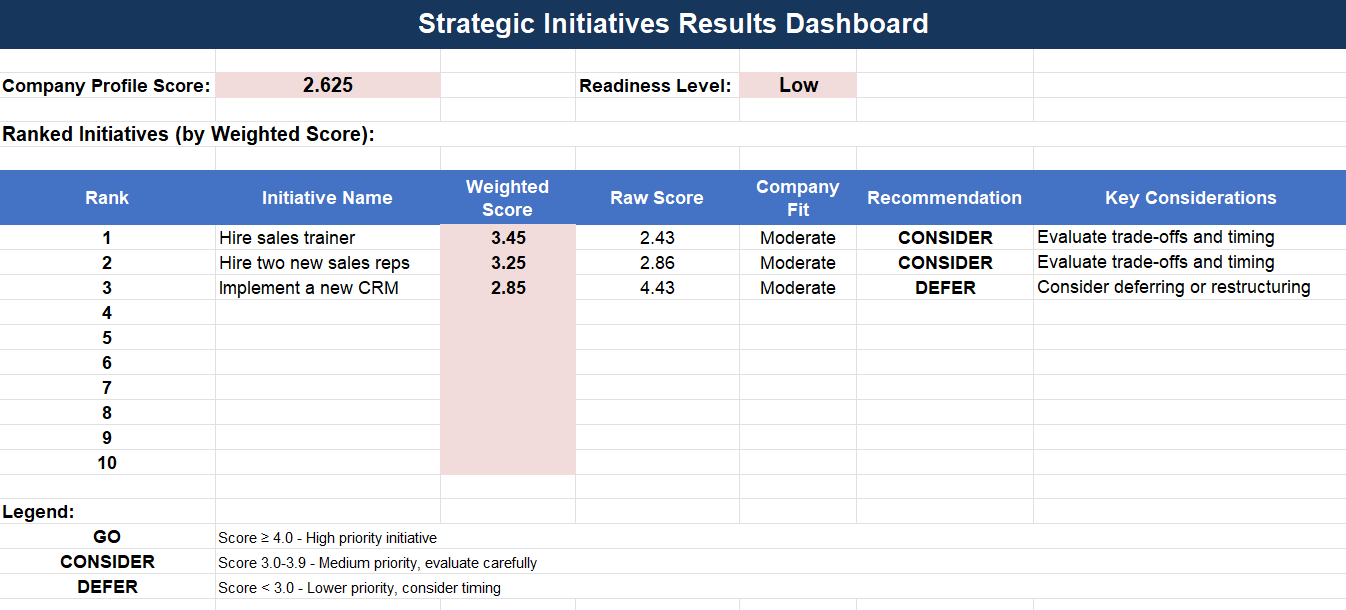
A screenshot from my Strategic Initiatives Scoring Tool. You can purchase it by clicking here.
Every small business leader faces the same dilemma: too many good ideas, not enough resources to pursue them all.
You sit down with your team for strategic planning, and the ideas flow freely. Launch a new product line. Expand into a new market. Upgrade your technology stack. Hire a sales team. Improve customer service. Build a mobile app. The list grows longer, and everyone is convinced their initiative is "the one" that will move the needle.
But here's the brutal truth: choosing the wrong initiatives doesn't just waste time and money… it can put your entire business at risk.
So how do you decide? How do you separate the game-changers from the resource drains?
The Problem with "Gut Feel" Decision-Making
Most small business leaders make strategic decisions based on a combination of intuition, the loudest voice in the room, or whoever made the most compelling case at the last leadership meeting.
This approach has several fatal flaws:
Personal bias clouds judgment. Your COO is convinced the operational efficiency project will save thousands. Your marketing director swears the rebrand will attract new customers. Your technology lead insists the cloud migration can't wait. Everyone has skin in the game, and objectivity goes out the window.
Recency bias skews priorities. The initiative that was discussed most recently, or the problem that caused the most pain last week, suddenly becomes "urgent", even if it's not the most strategic choice for long-term success.
Hidden costs get ignored. An initiative might look attractive on paper until you factor in the time drain on your best people, the opportunity cost of not pursuing other options, or the organizational change management required to make it work.
Company readiness gets overlooked. A high-potential initiative launched at the wrong time, like when your team is already stretched thin or your finances are tight, can fail spectacularly, not because it was a bad idea, but because the timing was wrong.
The result? You end up with a portfolio of half-finished projects, frustrated teams, and missed opportunities while your competitors move ahead with laser focus.
What You Really Need: Objective, Systematic Evaluation
Strategic initiative prioritization isn't just about scoring ideas, it's about creating a framework that removes emotion from the equation and ensures you're making decisions based on data, context, and organizational fit.
Here's what an effective prioritization system must do:
1. Evaluate initiatives on multiple dimensions
No single factor determines success. You need to assess expected value, required effort, risk level, financial investment, time to impact, innovation potential, and scalability. A project might score high on value but be too risky given your current financial position. Another might be low-effort but offer minimal strategic benefit.
2. Account for your company's unique profile
A risk-tolerant, well-capitalized company with abundant resources can pursue bold, long-term bets. A resource-constrained organization struggling with execution needs quick wins and low-risk initiatives. The same project that's perfect for one business could be disastrous for another.
3. Apply strategic weighting
Not all factors matter equally in every situation. If you're in growth mode, you might weight scalability and innovation more heavily. If you're in stabilization mode, you might prioritize lower risk and faster time-to-value. Your scoring system should flex to match your strategic priorities.
4. Provide clear, defensible recommendations
When you present your prioritization to the team, stakeholders, or board, you need to be able to explain why Initiative A ranks higher than Initiative B. Vague justifications like "it feels right" don't cut it. You need a transparent methodology that everyone can understand and trust.
Introducing the Strategic Initiatives Scoring Tool
I designed and developed the Strategic Initiatives Scoring Tool to solve exactly this problem. It's a comprehensive Excel-based framework that brings objectivity and rigor to your strategic planning process.
Here's how it works:
Step 1: Assess Your Company's Readiness
Before you evaluate any initiatives, you need to understand your organization's current state. The tool guides you through rating your company on eight critical dimensions:
Risk Tolerance: How comfortable is your organization with uncertainty and potential failure?
Financial Health: What's your current financial strength and ability to invest?
Resource Availability: Do you have the people, time, and capacity for new projects?
Execution Capability: What's your track record of delivering complex projects?
Strategic Clarity: How aligned is your leadership on priorities?
Innovation Culture: What's your organization's appetite for experimentation?
Time Horizon: How patient can you be for results?
Change Readiness: How well does your team adapt to change?
Each dimension is scored on a 1-5 scale, giving you an overall Company Readiness Score. This becomes your baseline and the lens through which all initiatives will be evaluated.
Step 2: Set Your Strategic Weighting
Not all businesses are pursuing the same strategy. The tool offers three preset strategic profiles:
Balanced: Equal weight across all factors for a comprehensive, neutral evaluation.
Quick Wins: Emphasizes speed to impact (20% weight), lower effort (25%), and manageable risk (15%). Perfect for businesses that need to show results fast or are operating with constrained resources.
Long-Term Value: Emphasizes strategic value (25%), innovation potential (25%), and scalability (20%). Ideal for well-resourced companies focused on building sustainable competitive advantages.
And if none of these fit? You can create your own custom weighting scheme that matches your exact strategic priorities.
Step 3: Score Your Initiatives
Now comes the evaluation. For each initiative (up to 10), you score it across seven dimensions:
Expected Value (1-5): What impact and benefit will this bring to the organization?
Effort/Complexity (1-5): How difficult will this be to execute? (Note: Lower scores here actually contribute positively to the final score)
Risk Level (1-5): What's the downside if this fails? (Again, lower risk scores higher)
Financial Investment (1-5): What's the capital requirement? (Lower investment scores higher)
Time to Impact (1-5): How quickly will you see results? (Faster scores higher)
Innovation Potential (1-5): Does this represent breakthrough thinking or learning value?
Scalability (1-5): Can this create lasting, compounding value over time?
The tool automatically inverts the scoring for effort, risk, financial investment, and time to impact so you're always rewarding the positive attributes while penalizing the negative ones.
Step 4: Review the Results Dashboard
The magic happens in the Results Dashboard. Here's what you get:
Ranked Initiatives: Your initiatives are automatically sorted by their weighted priority score, showing you exactly which projects should be pursued first.
Company Fit Analysis: Each initiative receives a "fit score" that compares its requirements against your company's readiness profile. A high-scoring initiative that's a poor fit for your current capabilities gets flagged.
Clear Recommendations:
GO (Score ≥ 4.0): High priority initiatives with strong alignment
CONSIDER (Score 3.0-3.9): Medium priority—evaluate trade-offs carefully
DEFER (Score < 3.0): Lower priority—consider restructuring or timing
Key Considerations: For each initiative, the tool provides contextual guidance on what to watch out for and what questions to ask before moving forward.
Why This Approach Changes Everything
It Removes Emotion from Decision-Making
When everyone on your leadership team fills out the same scoring framework independently, you force objective evaluation. No more debates driven by who's most persuasive or who has the CEO's ear. The numbers tell the story.
It Creates Organizational Alignment
With a transparent scoring methodology, everyone understands why certain initiatives are prioritized. This reduces second-guessing, minimizes political infighting, and gets everyone rowing in the same direction.
It Accounts for Context
Unlike generic prioritization frameworks that apply the same criteria to every company, this tool adapts to your unique situation. A startup with venture backing will get different recommendations than a bootstrapped service business, even if they're evaluating identical initiatives.
It Provides Documentation and Defensibility
When stakeholders question your decisions (and they will), you can point to the scoring framework and say, "Here's exactly how we arrived at this conclusion." This is especially valuable when dealing with board members, investors, or skeptical team members who wonder why their pet project isn't getting greenlit.
It Forces Clarity on Strategic Priorities
The act of choosing between "Balanced," "Quick Wins," and "Long-Term Value" weighting schemes requires you to be explicit about your strategy. Are you really committed to innovation, or are you just saying that? This tool makes you prove it.
Real-World Applications
Let's look at how this might play out in practice:
Scenario 1: The Resource-Constrained Association
A 15-person association has five initiatives on the table: expanding into a new service line, upgrading their CRM, hiring two new consultants, creating a content marketing program, and pursuing a strategic partnership.
Their Company Readiness Assessment reveals:
Low resource availability (currently at 95% utilization)
Medium risk tolerance
Medium financial health
High time pressure for revenue growth
They select the "Quick Wins" strategic weighting.
The tool recommends:
GO: Creating a content marketing program (low effort, medium value, fast impact)
CONSIDER: Upgrading their CRM (medium effort, medium-high value, improves efficiency)
DEFER: Expanding service line (high effort, high risk, long time to value)
DEFER: Hiring consultants (expensive, adds complexity when utilization is already high)
CONSIDER: Strategic partnership (medium effort, medium risk, could accelerate growth)
Without the tool, they might have impulsively hired consultants (the "obvious" solution to being busy) or pursued the exciting new service line. Instead, they focus on sustainable growth through content marketing while evaluating the CRM upgrade.
Scenario 2: The Well-Capitalized Tech Startup
A 35-person SaaS company just closed a Series A round and is choosing between eight growth initiatives: expanding internationally, launching a mobile app, building an API for third-party integrations, hiring a sales team, implementing advanced analytics, creating a partner program, upgrading infrastructure, and developing AI-powered features.
Their Company Readiness Assessment shows:
High financial health (18 months runway)
High risk tolerance
Medium execution capability (still maturing processes)
High innovation culture
Patient time horizon
They choose the "Long-Term Value" weighting.
The tool recommends:
GO: Building an API for integrations (high scalability, high innovation, medium effort)
GO: Developing AI-powered features (high value, high innovation potential, differentiating)
CONSIDER: Hiring sales team (medium-high value, improves revenue predictability)
CONSIDER: Expanding internationally (high scalability, but high complexity and risk)
DEFER: Launching mobile app (medium value, high effort, not strategically critical yet)
DEFER: Upgrading infrastructure (operational necessity but not value-creating)
The tool helped them focus on initiatives that build sustainable competitive advantages rather than spreading resources across everything.
Getting Started: Implementation Tips
If you're ready to bring systematic prioritization to your organization, here's how to make the most of this tool:
1. Do the Company Profile Assessment as a team
Have each member of your leadership team independently complete the Company Readiness Assessment, then compare notes. Where do you disagree? Those disagreements often reveal important conversations you need to have about your organization's true capabilities.
2. Be honest about strategic weighting
It's tempting to select "Long-Term Value" because it sounds more sophisticated, but if your business needs cash flow in the next six months, you should be using "Quick Wins." The tool only works if you're honest about your actual constraints and priorities.
3. Score initiatives independently before discussing
Have each decision-maker score the initiatives on their own first. Then come together to discuss scores and resolve differences. This prevents groupthink and ensures all perspectives are considered.
4. Revisit quarterly
Strategic priorities shift. A company's readiness profile changes as resources become available or challenges emerge. Re-run the scoring process each quarter to make sure you're still focused on the right initiatives.
5. Use it as a conversation starter, not a conversation ender
The tool provides recommendations, but you still need judgment. If an initiative scores low but your gut says it's critical, dig into why there's a disconnect. Maybe you've identified a factor the tool doesn't capture, or maybe you're rationalizing a poor strategic choice. Either way, the tool helps you have that conversation explicitly.
The Bottom Line
Strategic initiative prioritization isn't glamorous work. It doesn't involve exciting brainstorms or inspiring vision statements. But it's the difference between companies that execute with focus and companies that scatter their efforts across too many fronts.
Every hour you spend chasing the wrong initiative is an hour your competitors are gaining ground on the right ones.
The Strategic Initiatives Scoring Tool won't make your strategic decisions for you, but it will ensure those decisions are grounded in objective analysis, aligned with your company's unique context, and defensible to every stakeholder who asks, "Why are we doing this and not that?"
Because in the end, strategy isn't about having great ideas. It's about choosing which great ideas to pursue and which to set aside.
Are you ready to stop guessing and start prioritizing with clarity?
About the Tool
The Strategic Initiatives Scoring Tool is a comprehensive Excel-based framework designed specifically for small to mid-sized businesses (2-250 employees) who need systematic, objective methods for prioritizing strategic initiatives. It includes:
Company Readiness Assessment across 8 dimensions
Flexible strategic weighting (Balanced, Quick Wins, Long-Term Value, or Custom)
Initiative scoring framework with automatic weighted calculation
Results dashboard with ranked recommendations and fit analysis
Built-in formulas that account for your company's unique profile
Available for instant download at $39.
Perfect for: Business owners, leadership teams, strategic planning facilitators, and consultants who help small businesses make better strategic decisions.
Ready to bring clarity to your strategic planning? Download the Strategic Initiatives Scoring Tool and start making data-driven decisions today.
