The Executive Operating System: A Complete Framework
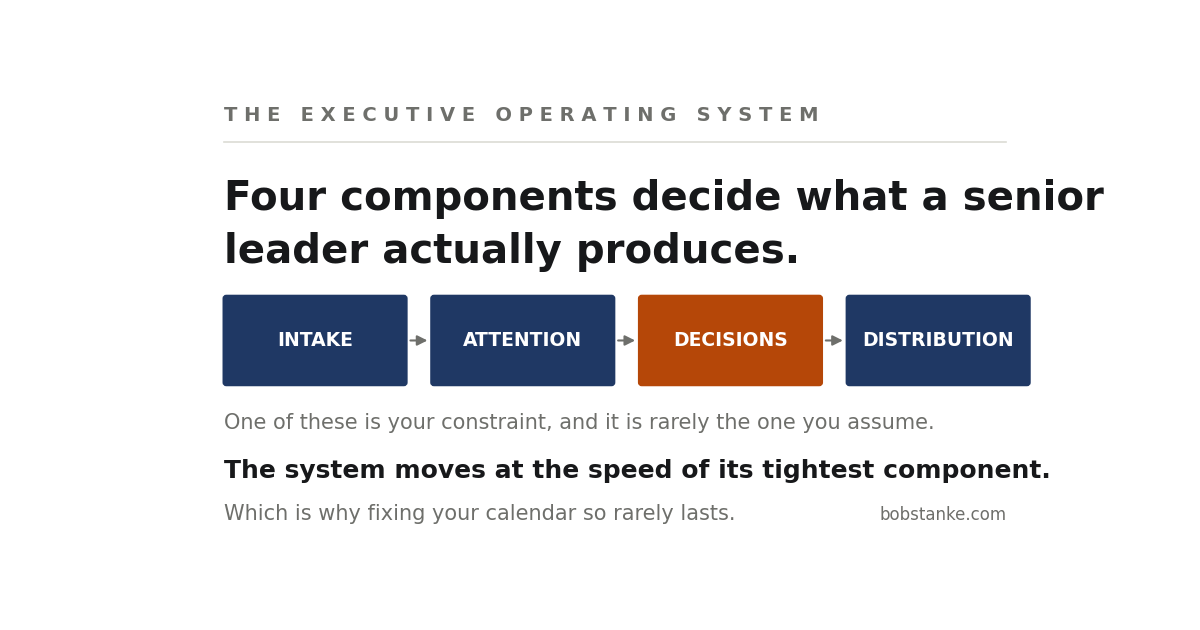
The Executive Operating System is the set of four components that determine what a senior leader actually produces: what reaches them, where their attention goes, how decisions clear, and what leaves their desk. The components run in sequence, and the whole system moves at the speed of the tightest one.
That last sentence is the part that matters, and it explains something most senior leaders have experienced without being able to name. You fix your week. It works. Within a month it has quietly reverted.
This is the complete framework: what the four components are, why they degrade on their own, how to tell which one is holding you back, and why almost everyone is wrong about their own answer.
Why the executive is the wrong unit of analysis
Nearly every attempt to improve executive performance targets the executive. Their skills, their habits, their presence, their discipline. Coaching, training, books, and most advice all point at the person.
Almost none of it points at the system the person operates inside.
That system exists whether or not anyone designed it. Usually nobody did. It accumulated: one recurring meeting, one added report, one escalation path, one standing invitation at a time. Every addition was reasonable. Nobody ever stepped back to look at the whole thing.
An executive is a system that converts attention into outcomes. When the output is disappointing, the instinct is to work on the converter. Very often the problem is in how the system is wired around it.
The central claim
Here is the argument the whole framework rests on, and it is what makes this a framework rather than a list of topics.
The four components are sequential, and the system runs at the speed of its tightest constraint. Improving a downstream component while an upstream one is broken produces no durable gain.
This is why executive time management fails so reliably.
A leader clears their calendar, protects two mornings a week, and feels transformed. Three weeks later the calendar has refilled. The intervention targeted where their time goes. The actual constraint sat one layer upstream, in what was allowed to reach them in the first place. Nothing about the inflow changed, so the outflow reverted.
The corollary is the useful part. Most executives are wrong about their own constraint. Nearly everyone reports a time problem, because time is where every constraint eventually shows its symptoms. It is rarely where the cause lives.
The four components
1. Intake: what reaches you at all
Channels, reports, escalation paths, notifications, and the standing invitations nobody ever declined. Intake is upstream of everything and it is the least examined component in executive work.
The diagnostic question: what is allowed to reach you, and who decided that?
The failure mode: everything arrives, nothing is filtered, and the executive becomes the router. Volume gets mistaken for importance.
Why it degrades on its own: anyone in your organisation can add a channel to your intake. Only you can remove one. Additions take thirty seconds and require approval from nobody. Every removal costs a conversation. So intake has hundreds of contributors and exactly one editor, and the editor is busy.
How you know it is your constraint: fixes you make elsewhere revert within a month, and work reappears from a different direction each time you clear it.
Deep dive: how to design your intake.
2. Attention: where your time actually goes
The calendar, the meeting portfolio, the shape of the week, and whether uninterrupted blocks exist anywhere in it. This is the component everyone assumes is the whole system.
The diagnostic question: does the shape of your week match the shape of your job?
The failure mode: a full calendar of meetings you attend but do not drive. Thinking happens outside working hours or not at all.
Why it degrades on its own: declining has a visible cost and an invisible benefit. Say no and a specific person is specifically disappointed today. Say yes and the cost is thinking that now will not happen, which nobody was expecting and nobody will miss. People systematically over-weight what is visible and attributable, so the calendar does not drift randomly. It ratchets, in one direction, permanently.
How you know it is your constraint: your inflow is genuinely managed and work does leave your desk, but the week is still fragmented into pieces too short to hold a real problem.
Deep dives: your calendar is the most honest strategy document in your company, how to audit your own calendar in 30 minutes, and why you don't have two hours to think.
3. Decisions: what you resolve, and how fast
Decision rights, decision latency, escalation quality, and the difference between reversible and irreversible calls.
The diagnostic question: which decisions genuinely require you, and how long do they wait?
The failure mode: everything routes to you for approval. Reversible decisions receive irreversible-decision scrutiny. The organisation stalls while it waits.
Why it degrades on its own: when ownership of a decision is unclear, the decision escalates. For anyone below you, deciding carries personal risk and escalating carries none. So the individually rational move is always to send it up. Ambiguity has a direction, and the direction is your desk.
How you know it is your constraint: you have available time and manageable inflow, but work sits. Your team describes itself as blocked rather than overloaded, which is a completely different sensation and one you never have.
Deep dive: map your decision rights.
4. Distribution: what leaves your desk
Delegation, span of control, capability in the layer below, and what breaks when you are unavailable.
The diagnostic question: what are you holding that someone else should own, and why haven't they?
The failure mode: the executive is the bottleneck and the team's ceiling. Work is delegated as tasks with instructions rather than outcomes with authority, so it comes back.
Why it degrades on its own: "it is faster if I do it" is almost always true, and it is a statement about the past rather than a reason about the future. The reason you are faster is that you have always done it. Every instance you keep makes you slightly faster and leaves your team exactly where they were. The gap you use to justify holding the work is a gap you are actively widening.
How you know it is your constraint: your time is protected and decisions clear quickly, but a week of unplanned absence would stop things entirely.
Deep dive: find your single points of failure.
Alignment: how you know whether any of it is working
Alignment is not a fifth component. It is what the system produces, and it is the number that tells you whether the machine is pointed at anything useful.
The Alignment Gap is the distance between an executive's stated priorities and their actual allocation of time, decisions, and delegated capacity.
Every executive can name their top three priorities immediately and with conviction. Almost none can survive having that answer compared against sixty days of their own calendar.
The gap is usually large, always uncomfortable, and entirely factual, which is what makes it the most persuasive number in this work. It is also the right measure of the system because it is agnostic about cause. A large gap proves the system is misaligned. The four component scores tell you where.
The four levels
A rough progression, useful for locating yourself.
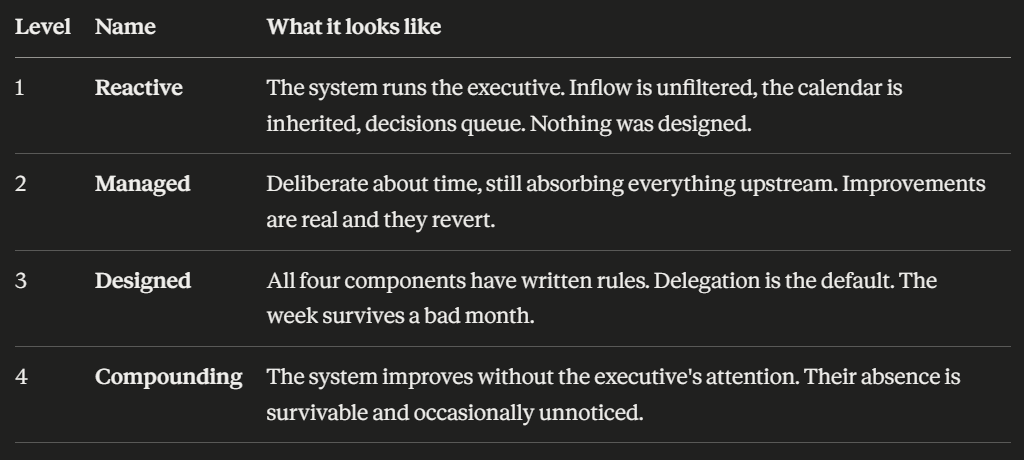
Most senior leaders sit at level 1 or 2. Level 3 is a realistic ninety day target. Level 4 depends on the team as much as the individual and takes years.
Why you are probably wrong about your own constraint
Three things conspire here, and they are worth naming because they are the reason this is hard to self-diagnose.
Time absorbs the symptoms of everything. A broken intake shows up as a full calendar. Slow decisions show up as a full calendar. Poor delegation shows up as a full calendar. The calendar is an excellent diagnostic and a terrible cause.
You only experience one side of it. If decisions are your constraint, you experience a long list. Your team experiences being blocked. Nobody sends you a report on how many days work waited for you.
The visible problem is rarely the upstream one. People reliably self-prescribe interventions one layer below their actual constraint, because that is the layer they can see. Then the change reverts and they conclude they lack discipline.
Early evidence from the assessment behind this framework is consistent with that, though the sample is still small. Among the first handful of respondents, every single person who had previously attempted a change to how they work reported that it came back. Most within weeks. That is a pattern worth watching rather than a finding worth citing, and I will publish real numbers once there are enough of them to mean something.
How to use this: diagnose in order, intervene at the constraint
Diagnose in flow order. Intake, then Attention, then Decisions, then Distribution. Upstream components mask downstream ones, so you cannot judge whether your decisions are slow until you know whether the right things are even reaching your desk.
Intervene at the constraint, not the symptom. The lowest-scoring component gets the first ninety days regardless of where it sits in the sequence.
When no single constraint is obvious, the default order is:
Distribution. Creates immediate capacity and produces a visible win in week two.
Intake. Stops the refill, which is what makes everything else durable.
Attention. Rebuild the week now that there is room to rebuild it into.
Decisions. Speed up whatever legitimately remains.
Distribution goes first for a practical reason. The executive needs to feel the system move before they will accept the harder upstream work.
What this framework is not
Boundaries are what keep a framework from becoming a general theory of everything.
Not interpersonal. Presence, influence, feedback, and difficult conversations are a real discipline. This is not it, and this framework assumes competence there.
Not strategy. It will not tell you what your priorities should be. It measures and closes the gap between your stated priorities and your actual behaviour.
Not wellness. Energy and burnout are adjacent and real. Not this.
Not org design. It operates on one executive's system, though it will surface organizational problems that sit outside its scope.
Where to start
You cannot fix what you have not located, and the whole point of the sequence is that working on the wrong component is worse than doing nothing, because it costs you a quarter and teaches you that this does not work.
The fastest way to find your constraint is to measure all four.
The Executive Operating Index scores the four components in about five minutes and names the one that is actually binding. It is free, and your score appears before you are asked for anything.
FAQ
What is an executive operating system? The four components that determine what a senior leader produces: what reaches them, where their attention goes, how decisions clear, and what leaves their desk. It exists whether or not it was designed, and in most organizations it accumulated rather than being chosen.
Why does executive time management usually fail? Because the calendar is where symptoms appear rather than where causes live. Clearing a calendar changes your availability, not your inflow. If the channels and defaults that filled it are untouched, the space gets reclaimed, usually within a month.
How do I know which component is my constraint? The clearest signal is reversion. If changes you have made came back within weeks, the cause is almost certainly upstream of whatever you changed. Beyond that, each component has a distinct signature, described in the sections above.
Can I work on more than one component at once? You can, and it is usually a mistake. An executive handed four areas to improve improves none of them. The sequence exists because upstream fixes make downstream ones hold.
How is this different from executive coaching? Most coaching works the interpersonal layer. This works the operating layer. Both matter, they are different disciplines, and almost everyone works the first one.
How long does it take to move a level? Reactive to Managed can happen in weeks. Managed to Designed is realistically a ninety day project. Designed to Compounding depends on the capability of the layer below you and is measured in years.
Bob Stanke is a Chief of Staff, the role companies create when an executive's operating system has outgrown them. He writes about the operating layer of executive work: what reaches you, where your attention goes, how decisions clear, and what leaves your desk.
