Fractional Chief of Staff Cost
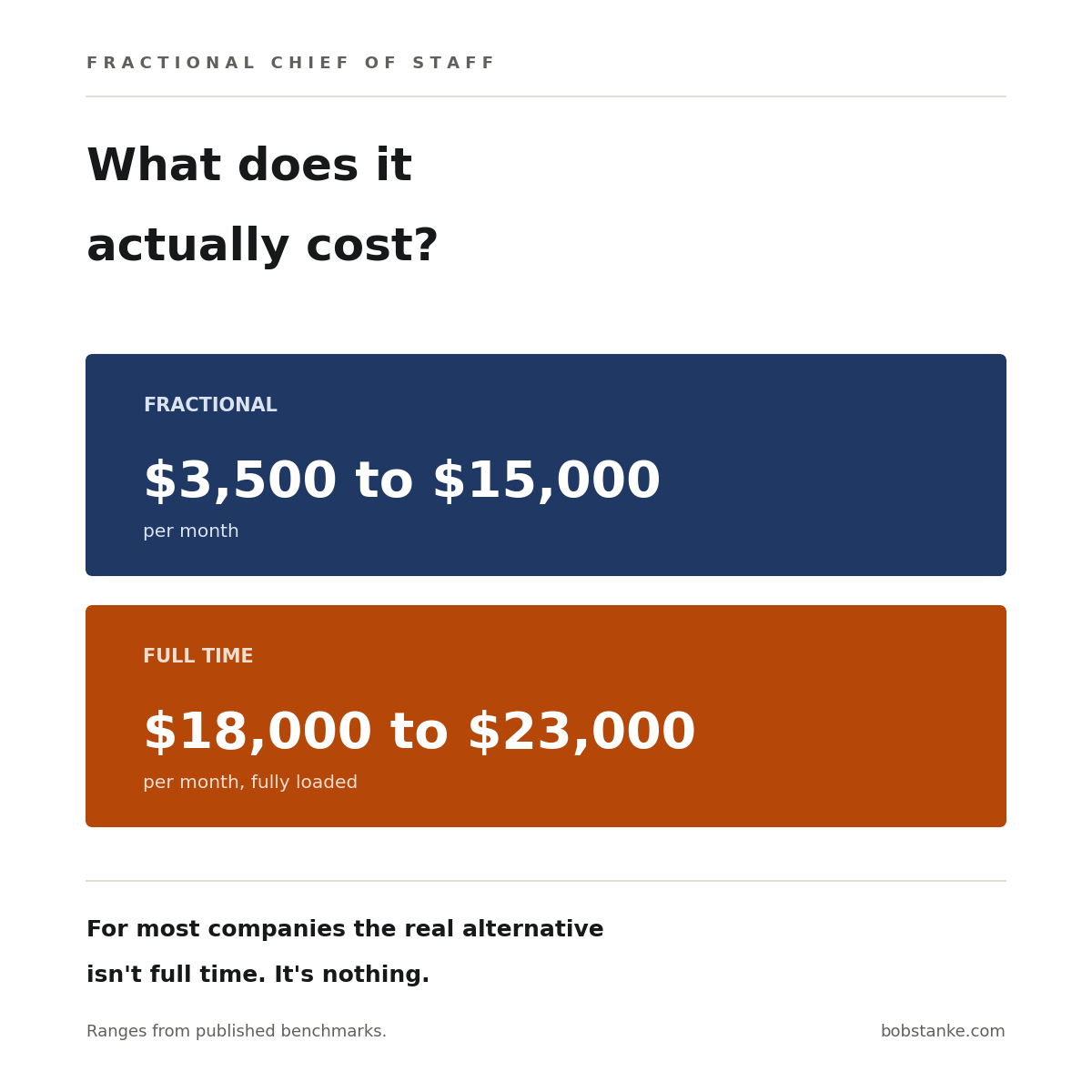
Most fractional Chief of Staff engagements run between $3,500 and $15,000 per month, depending on how many days a week are committed and how much of the work is judgment rather than execution. Day rates typically land between $1,200 and $2,500. Hourly arrangements exist and usually sit between $150 and $250.
Those are wide ranges because the role is wide. What follows is what actually moves the number, what you get at each level, and the situations where you should not hire one at all.
I hold the Chief of Staff role. I also do fractional work, so treat the last section accordingly and judge the rest on whether it is useful.
The four pricing models
Monthly retainer. The most common structure. You commit to a number of days per month and pay a fixed fee. Predictable for both sides, and it works because the value of the role is continuity rather than output. Someone who only appears for discrete projects cannot hold the decision list or know what is stuck.
Day rate. Useful for engagements under two months or for work with a defined end. Typically $1,200 to $2,500 per day. Slightly more expensive per unit than a retainer, which is the trade for flexibility.
Project fee. A fixed price for a defined deliverable: an operating audit, a decision rights build, a ninety day install of a specific system. This is the lowest risk way to start with someone, because the scope is legible before you commit. (My most recent fractional engagements were project fee based.)
Hourly. Least common and usually the worst structure for this work. The incentives point in the wrong direction, since the job is largely about reducing volume, and any arrangement that pays more for more hours is quietly working against you. If you use it, cap it.
What the range actually depends on
Five things, in rough order of how much they move the number.
Days committed. The dominant factor. One day a week and three days a week are different jobs, not just different quantities of the same job.
Judgment versus execution. A fractional Chief of Staff who is triaging inbound, holding the decision list, and telling you plainly when a plan is not working costs more than someone running project trackers. Both are legitimate. Only one of them is the role.
Seniority and operating background. Someone who has held the seat inside a company prices differently from someone who has read about it. This is the variable where you should be most willing to pay up, because the value of the role is almost entirely judgment.
Company complexity. A hundred person company with three functions is a different problem from a thousand person company with twelve, regardless of how many days you buy.
Embeddedness. Attending your leadership meetings, being in your systems, and being reachable during your working hours costs more than an arrangement that is genuinely part time and asynchronous. It is also considerably more useful.
| Fractional | Full time | |
|---|---|---|
| Monthly cost | $3,500 to $15,000 | Roughly $18,000 to $23,000 |
| Annual cost | $42,000 to $180,000 | $215,000 to $280,000 fully loaded |
| Ramp time | Days to weeks | Two to three months |
| Commitment | Usually 3 to 6 months | Indefinite |
| Availability | Defined days | Full time |
| Institutional depth | Moderate | High and compounding |
| Hiring risk | Low, easy to end | High, the role is hard to hire well |
Scroll the table sideways to see both columns.
Figures are directional ranges drawn from published fractional and full time benchmarks. Full time cost includes benefits, equity, and overhead.
Two honest observations about that table.
At the top of the fractional range you are approaching full time cost. If you are paying $15,000 a month for three days a week and the arrangement has run a year, the economics are telling you something. That is usually the point to hire, and a good fractional person will say so.
The comparison people usually make is the wrong one. The question is not whether fractional is cheaper than full time. It is whether you would hire full time at all. For most companies in this position the honest alternative to fractional is nothing, and the relevant comparison is against continuing as you are.
What the person earns versus what you pay
Buyers ask this, and most pricing pages avoid it. It is worth answering plainly, because understanding the gap tells you when a rate is reasonable and when it is a warning sign.
The two numbers are not the same, and the difference is larger than it looks.
A full-time Chief of Staff earns roughly $160,000 to $210,000 in base salary. The company pays $215,000 to $280,000 once benefits, payroll taxes, equity, and overhead are counted. That gap is invisible to the employee and very real to the employer.
Fractional works the same way in reverse. What you pay is not what the person takes home.
Someone working with you two days a week at $8,000 a month is not earning $96,000 a year from you plus the same again from everyone else. Out of that rate they cover:
No benefits. Health insurance, retirement, all of it, paid personally.
Self-employment tax, which is roughly double the payroll tax an employee sees.
No paid time off. A week not worked is a week not billed.
Utilization gaps. Almost nobody is engaged 100% of available days. Fifty to seventy percent is a realistic range once you account for gaps between engagements.
Unbilled hours. Business development, proposals, admin, and the reading that keeps them useful to you. None of it is billable and all of it is necessary.
Run that math and a rate that looks high next to a salary usually is not. The effective annual income behind a $10,000 monthly retainer, once you strip out the items above, tends to land in the same neighborhood as the full-time equivalent rather than above it.
Why this is worth knowing as a buyer:
It gives you a floor. A quoted rate substantially below the ranges above is not a bargain, it is a signal. Either the person is inexperienced, or they are carrying too many clients to give yours real attention, or they have underpriced and will raise it or leave within a year. None of those are good outcomes for you.
The most useful thing about understanding the gap is that it stops you optimizing for the wrong number. The cheapest arrangement is rarely the one that lasts, and continuity is most of what you are buying.
What you get at each level
Roughly one day a week, $3,500 to $6,000 a month. Enough to build and maintain the operating layer, not enough to run it daily. Suits an executive who needs the system designed and held rather than someone in every room. Expect written decision criteria, a maintained list of what is stuck, a weekly cadence that actually functions, and someone who reads your calendar honestly.
Roughly two days a week, $6,000 to $10,000 a month. The most common arrangement. Adds real intake triage, attendance at your leadership meetings, and enough continuity to chase things properly rather than just notice them.
Three days a week or more, $10,000 to $15,000 a month. Close to embedded. At this level the person is functionally part of your leadership team's rhythm. This is also the level at which you should be honest about whether you are buying fractional because it suits the work or because it avoids a hiring decision.
What it should not cost, and four things to watch for
A quote before a conversation about scope. Anyone who can price this from an email has not understood the problem. The number depends entirely on what is broken, and finding that out takes a discussion.
Twelve month lock-ins at the start. Three months is a reasonable initial commitment. Longer at the outset transfers all the risk to you before either side knows whether it works.
Uncapped hourly. Already covered, and worth repeating. The job is to reduce volume. Never pay per unit of volume.
Agency markup with no named person. The value here is one person's judgment and one relationship. If you cannot find out exactly who will do the work before you sign, you are buying staffing rather than expertise.
Is it worth it?
The honest version of this is harder to write than the usual one.
The standard argument compares the fee to an executive's hourly cost and declares an obvious return. That calculation is close to meaningless, because it assumes the hours freed up get spent on something valuable, and frequently they do not. Time released into an undesigned system just gets absorbed.
The better question is what is currently not happening.
If decisions are sitting for three weeks, something downstream of those decisions is not moving, and that has a real cost you can usually name. If your strategic work has not advanced in two quarters, that is the thing you are actually buying back. If your best people are leaving because the interesting work never reaches them, the cost of the role is not the comparison to make.
If you cannot name what is not happening, do not hire anyone yet. Find that out first. It is cheaper and it makes the eventual hire much better scoped.
When fractional is the wrong answer
Four situations where I would tell you not to do it.
You need someone in the building daily. If the work genuinely requires being in every room, every day, reading the temperature of the organization continuously, that is a full time role. Fractional does the operating layer well and does ambient presence poorly.
You need someone to own a function. That is a COO or a functional leader. A Chief of Staff has no line authority and cannot own an outcome, and asking a fractional one to do so guarantees frustration on both sides.
The problem is capability below you. If work fails when delegated because the layer beneath you cannot yet carry it, no amount of routing improves that. That is a hiring and development problem wearing a different costume.
You actually needed an executive assistant. A meaningful share of people exploring fractional Chief of Staff work have a logistics and coordination problem. A great EA costs a fraction of this and solves it better.
How to scope it so you do not overpay
Three moves, and they will save you more than negotiating on rate.
Start with a diagnostic, not a retainer. A defined piece of work with a fixed fee tells you whether the person is any good and tells them what is actually broken. Both sides learn something before anyone commits to a year.
Know your constraint before you buy. This is the one that matters most. Four components determine what a senior leader produces, and most executives are wrong about which of theirs is binding. Nearly everyone reports a time problem. The actual cause is usually upstream in what reaches them or downstream in what never leaves. Hiring someone to fix the wrong component is an expensive way to find that out.
Write the scope down. What they own, what they influence, what they do not touch. Verbally agreed scope becomes contested scope by month two, and contested scope is how these engagements quietly fail.
Where to start
If you have read this far, you are probably somewhere between "this is a real problem" and "I do not know what I would actually be buying."
That gap is worth closing before you spend anything.
The Executive Operating Index scores all four components in about five minutes and names the one actually holding you back. It is free, your score appears before you are asked for anything, and it will tell you whether the problem you are trying to solve is the one you think it is.
If it turns out you need the function, here is what the role actually does and how to tell whether it is time.
FAQ
How much does a fractional Chief of Staff cost per month? Typically $3,500 to $15,000 depending on days committed. Around one day a week sits at the lower end, three days or more at the upper end.
What is a typical fractional Chief of Staff day rate? Usually $1,200 to $2,500 per day. Day rates run slightly higher per unit than retainers, which is the normal trade for shorter commitment.
Is fractional cheaper than hiring a full time Chief of Staff? Almost always, since a full time hire runs roughly $215,000 to $280,000 fully loaded. But the more useful comparison is against doing nothing, because for most companies at this stage that is the real alternative.
How long do fractional engagements last? Three to six months is a common initial commitment, frequently extended. Be cautious about anything longer at the very start.
What is the minimum commitment worth making? Below roughly one day a week the role struggles to be useful, because continuity is where the value comes from. A one off project is a reasonable way to start, but a very thin ongoing retainer usually disappoints both sides.
How do I know if I need one at all? The signals are that requests and decisions route through you personally, work is visibly waiting on you, and that has been true for more than one busy quarter rather than one hard month.
What does a fractional Chief of Staff earn? Not the same as what a client pays. Out of the retainer the person covers benefits, self-employment tax, unpaid time off, gaps between engagements, and unbilled business development. Effective income behind a $10,000 monthly retainer usually lands near full-time equivalent rather than above it.
Bob Stanke is a Chief of Staff and Executive Advisor, and does fractional Chief of Staff work. He writes about the operating layer of executive work: what reaches you, where your attention goes, how decisions clear, and what leaves your desk.
