First 90 Days as a New Executive
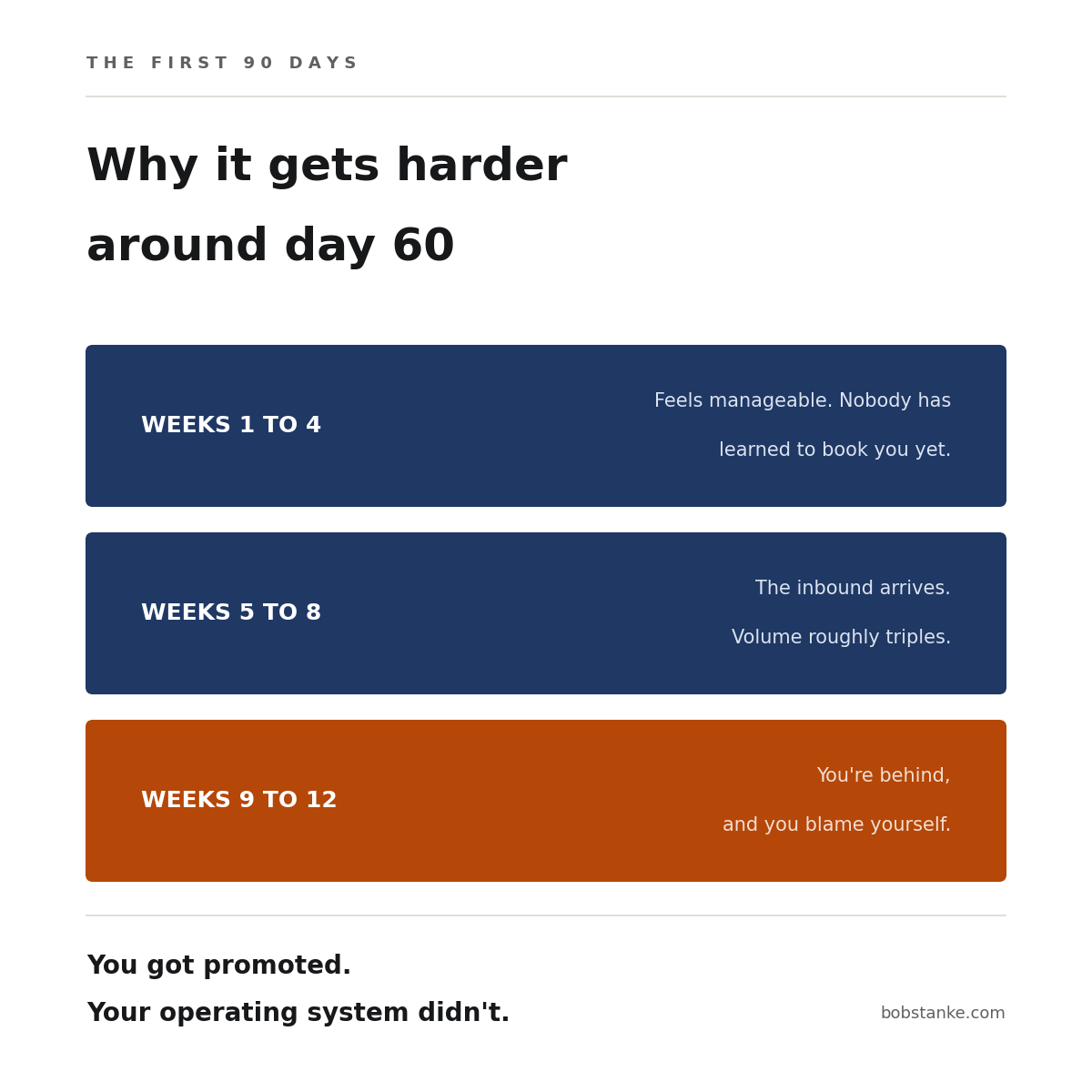
You got promoted. Your operating system didn't.
Almost everything written about the first ninety days is about what to do: map stakeholders, secure early wins, learn the business, build relationships. All of that is sound and all of it is downstream of the thing that actually causes new executives to struggle around day sixty.
The way you worked at your previous level was good enough to earn you this job. It is not good enough to do this job, and nobody says so, because it looks like a character issue rather than a design one. One example of this I have written about is when a Director gets promoted to a VP position.
The timeline almost everyone follows
The pattern is consistent enough to predict.
Weeks one to four. It feels manageable, sometimes surprisingly so. Your calendar is light because nobody has learned to book you yet. You are meeting people, reading, asking questions. There is a honeymoon quality to it.
Weeks five to eight. The inbound arrives. You are now properly in the org chart, on the distribution lists, in the escalation paths, and in everyone's mental model of who to ask. Volume roughly triples, and it feels like it happened overnight, and none of it announces itself as a change.
Weeks nine to twelve. You are behind. Strategic work you promised has not started. You are working evenings. And you reach one of two conclusions, both wrong: that you need to work harder, or that you were not ready for this.
The reason the difficulty arrives at day sixty rather than day one is that a new executive's problems are all lagging indicators. Nothing broke on your first day. It broke when the volume caught up with a system that was never designed for it.
What actually changed
Four things shifted the moment your title did, and none of them are about skill.
You inherited someone else's operating system
The meeting cadence, the standing reports, the escalation paths, the recurring reviews. You did not build any of it. Your predecessor did, for their own working style, and possibly the person before them.
Nobody will tell you that you are allowed to change it. It is presented as how things work here, and questioning it in your first month feels presumptuous. So most new executives inherit a system built by and for a different person and quietly assume the friction is theirs.
Everyone can reach you now, and you cannot yet filter
At your previous level you knew what was safe to ignore. That knowledge was invisible and it did enormous work.
New in role, you have no such filter. Every request could be important, so all of them get read. Every meeting might contain context you need, so you accept. Being new makes you structurally unable to filter, exactly when the volume of things needing filtering has multiplied. That combination is what makes month two so much harder than month one.
You hold decision rights you do not have context for
Decisions now arrive that were previously two levels above you. You have the authority immediately and the context slowly, and that gap is uncomfortable enough that many new executives over-deliberate everything.
Worse, nobody has told you which decisions are actually yours. In the absence of a rule, everything routes upward, and now upward means you.
You have a team you have not learned to trust
Delegation depends on knowing who is reliable at what. You do not know that yet, and it takes a quarter to learn.
So you hold work. Reasonably, in the short term. But holding work is how you become the bottleneck, and the habits formed in month two are surprisingly hard to reverse in month six.
Why the standard advice does not fix this
Stakeholder mapping, quick wins, and listening tours are genuinely useful and they are all content recommendations. They tell you what to spend your attention on.
None of them address how much attention you have, what reaches you, what decisions queue on your desk, or what leaves it. Those four things determine whether you can execute any of the advice at all.
An executive who has been told to secure an early win, but whose week is fragmented into thirty minute pieces by an inherited meeting schedule, will not secure an early win. Not for lack of trying.
What to do instead, in the first 90 days
Four moves, one per component, in this order. The order matters, because each one makes the next possible.
Days 1 to 30: audit what you inherited
Do not change anything yet. Write down what exists.
Every recurring meeting on your calendar, with a note on what decision it produces. Every standing report you receive. Every channel people use to reach you. Every category of decision that has come to you and who else could have made it.
Ask one question about each item: would I have created this? You will not act on the answer for another month, but the list itself is the most valuable artefact of your first thirty days, and it becomes impossible to write once everything feels normal.
This is also the only window in which you can ask naive questions without cost. Use it.
Days 30 to 60: cut inbound before you touch the calendar
This is the step almost everyone skips, and skipping it is why the other three do not hold.
Take the channel list from your audit. Most senior leaders find nine to twelve separate ways people can reach them and would have guessed four. Consolidate hard.
Then take the standing reports. Pick the one you are least sure about and stop it without announcing anything. If nobody asks in three weeks, you have learned something exact. The mechanics of this are here.
Doing this before you rebuild your calendar is what makes the calendar changes survive. Clearing time without changing inflow gets you about three weeks.
Days 45 to 75: write down what does not need you
You now have enough context to say which decisions are actually yours.
Four or five lines is enough. Something reaches you if it crosses a spending threshold you name, affects a named customer or partner, sets a precedent, cannot be reversed, or crosses into another team. Everything else gets decided below you and reported afterward.
The reason this matters so much for a new executive is that your team is currently over-escalating on purpose. They do not know your thresholds, and guessing wrong upward is safer than guessing wrong downward. Written criteria are what stop that, and until they exist your team will keep sending everything, correctly.
Days 60 to 90: name what stops without you
By now you know your team well enough to answer this honestly.
Write down what would stop entirely if you were unavailable for a week starting tomorrow with no notice. Not a planned holiday, which hides the answer because everyone prepares.
Then, for each item, name a second person. Most of them are simpler to fix than they feel, and doing this at ninety days rather than at eighteen months is the difference between a habit and an excavation.
The trap worth naming
Around week ten, working harder starts to look like the answer. It is available, it is virtuous, and it produces visible short term results.
It is also the single most common reason new executives plateau.
Effort applied to an inherited system produces improvement that lasts about a month, then reverts, and each reversion makes you more convinced the problem is you. Meanwhile the actual constraint, which is a system built for someone at a different level doing a different job, sits untouched and unexamined.
The thing that separates executives who settle into the role from those who never quite do is not effort. It is whether they redesigned the system in the first six months or inherited it permanently.
How to tell whether it is working
Three numbers, checked at day ninety.
Hours per week in meetings. If it has climbed steadily since week one and never fallen, your calendar is being authored by other people.
Uninterrupted blocks of two hours or more. Count them for a normal week. Zero or one means you have no capacity for the work you were actually promoted to do, regardless of how full the week looks.
Percentage of your time on your stated top three priorities. Write the three from memory, then check them against sixty days of calendar. Most people estimate thirty or forty percent. The number that comes back is usually much lower, and the gap is the clearest evidence available that the system needs redesigning rather than the person.
If you want those four components scored properly, the Executive Operating Index does it in about five minutes and names the one holding the rest back. It is free, and your score appears before you are asked for anything.
One thing worth knowing
The people who struggle at this transition are not the ones who were promoted too early. In my experience they are frequently the opposite: people who were exceptional at the previous level precisely because they could absorb enormous volume through personal effort.
That capability is what earned the promotion. It is also what makes the new job harder, because it delays the moment you accept that absorbing volume personally has stopped being viable.
Nothing about that is a failure of readiness. It is a system that needs designing rather than inheriting, and ninety days is the easiest window you will ever have to do it.
FAQ
Why is the first 90 days in a new executive role so hard? The difficulty usually arrives around day sixty rather than day one, because volume takes weeks to catch up with a new title. By then you are operating an inherited system at a level it was not built for.
What should you do in the first 30 days as a new executive? Audit rather than change. Write down every recurring meeting, standing report, inbound channel, and category of decision reaching you. Ask whether you would have created each one. It is the only window where naive questions are free.
Should I change things in my first 90 days? Yes, but in a specific order: inbound first, then decision criteria, then delegation, then the calendar. Reversing that order produces changes that revert within a month.
How do I know if I am struggling or just adjusting? Adjusting improves. If your meeting hours have climbed every month, you have no uninterrupted blocks, and your stated priorities are getting a fraction of your week, that is a design problem rather than an adjustment period.
Is it normal to feel behind at 60 days? Extremely. It is close to the standard experience, and the timing is predictable enough that it says more about how the role works than about you.
What is the most common mistake new executives make? Working harder inside a system they inherited without examining it. Effort produces about a month of improvement and then reverts, and each reversion makes the person more convinced the problem is them.
Bob Stanke is a Chief of Staff and Executive Advisor. He writes about the operating layer of executive work: what reaches you, where your attention goes, how decisions clear, and what leaves your desk.
