EOS Integrator vs Chief of Staff: Which One Do You Actually Need?
One note before we start, because the initials collide unhelpfully.
EOS here means the Entrepreneurial Operating System, the management framework from Gino Wickman's Traction, used by thousands of small and mid-sized companies. The Executive Operating System I write about elsewhere on this site is a different thing with an unfortunate overlap in abbreviation. Both come up below and I will keep them apart.
Now the actual question.
The one-line answer
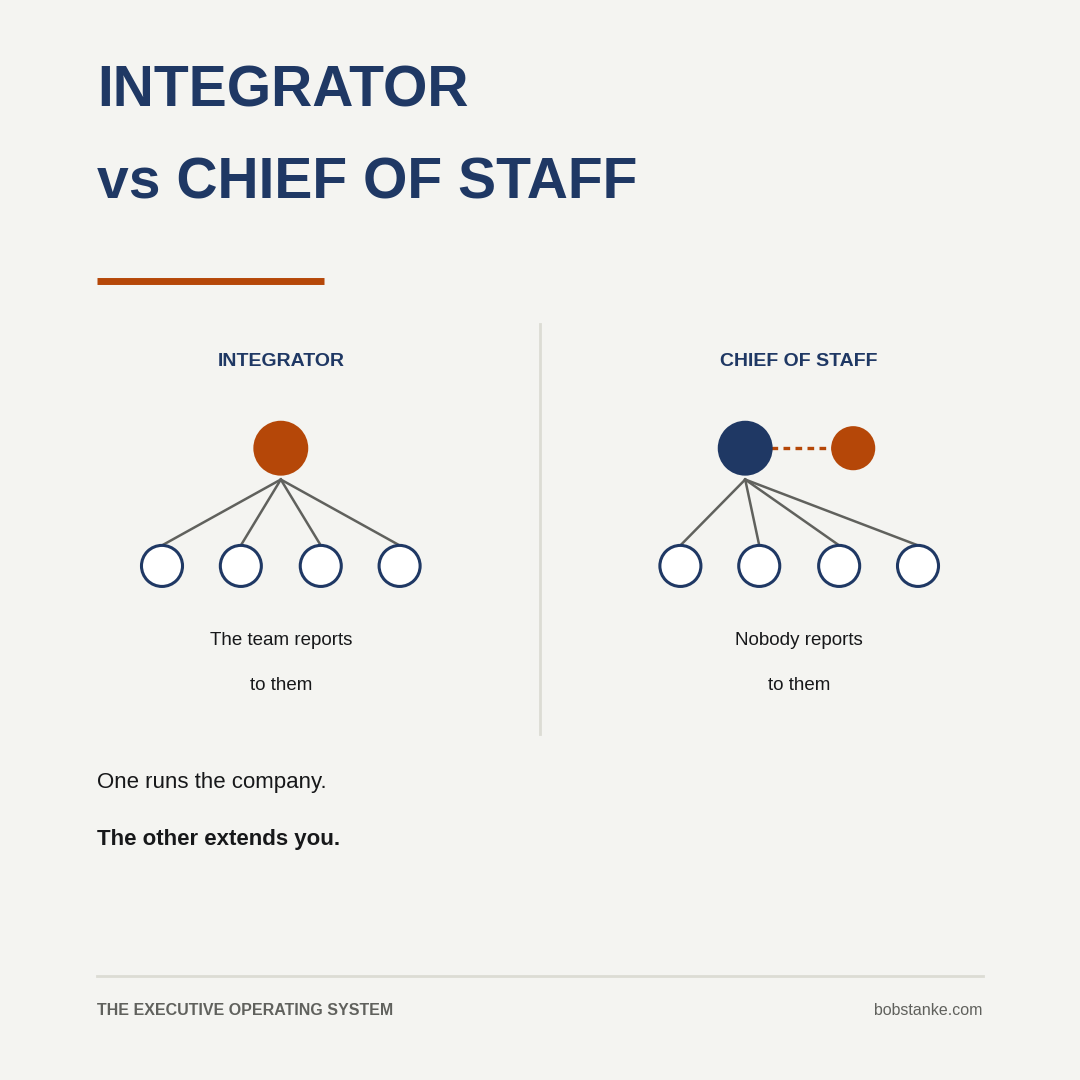
The Integrator runs the company. The Chief of Staff extends you.
Everything else follows from that, and most of the confusion in this decision comes from skipping it.
An Integrator sits in a seat on the Accountability Chart with the leadership team reporting to them. They hold those leaders accountable, resolve cross-functional issues, and carry the tiebreaker when the leadership team cannot agree. They run the Level 10 meeting because running it is the job. In most companies the title on the door is President, COO, or General Manager.
A Chief of Staff usually has nobody reporting to them. Their authority is not in the seat, it is on loan from the principal, and it evaporates the moment that person stops backing them. They work across every function without owning any of them.
One is a line role. The other is a staff role. That single structural difference produces every other difference in the table below.
The comparison
| EOS Integrator | Chief of Staff | |
|---|---|---|
| Who reports to them | The leadership team | Usually nobody |
| Where authority comes from | The seat itself | Borrowed from the principal |
| Accountable for | Company results | The principal's effectiveness |
| Runs the Level 10 | Yes. That is the job. | Sometimes, on someone else's behalf |
| What the founder gives up | Day to day control of operations | Very little |
| Typical title | President, COO, General Manager | Chief of Staff |
| Right when | You want out of operations | You want to stay in, with less friction |
Scroll the table sideways to see both columns.
One is a line role and the other is a staff role. Every difference above follows from that.
The question that actually decides it
Not company size. Not budget. Not whether you run EOS.
Do you want to keep running the company day to day?
If the answer is yes, and the problem is that too much reaches you and decisions are piling up, you need a Chief of Staff. You are staying in the seat. You want the seat to be survivable.
If the answer is no, and what you actually want is to focus on vision, relationships, product, or big deals while somebody competent runs the operation, you need an Integrator. In EOS terms you are the Visionary and you are looking for the other half of that pair.
Most founders can answer that question honestly in about ten seconds. The trouble is that almost nobody asks it before writing the job description.
The trap, and it is the common one
Founders who need an Integrator hire a Chief of Staff instead.
The reasoning is never explicit, and it goes something like this. You know operations are eating you. You also do not want to hand the company to someone. A Chief of Staff sounds like the version where you get help without giving anything up, and it is cheaper, and the search is easier, and nobody has to be told they now report to a new person.
So you hire one, and you hand them the work of an Integrator without the seat that makes that work possible.
What happens next is predictable. They are accountable for outcomes they have no authority to produce. They ask your VPs to do things and the VPs check with you first, which is rational, since you are still the actual decision maker. Every issue routes back through you anyway, which was the original problem. Eighteen months later they leave, and you conclude that the Chief of Staff role does not work.
The role worked fine. You hired it to solve a problem it structurally cannot solve.
The reverse happens too and costs more. You hire a real Integrator, give them the title and the reporting lines, and then keep making the calls yourself. Now you have an expensive senior executive publicly holding authority you have quietly retained, which the leadership team will notice within about a month. That person leaves faster, and takes a more visible failure with them.
The asymmetry underneath both traps
Every part of an operating system has a place where two things that look paired come apart. Here is this one.
You can hand someone responsibility in a single conversation. Handing them authority takes months, and you have to keep doing it.
Responsibility transfers the moment you say the words. Authority only transfers through repeated public deference: routing questions to them in front of others, declining to overrule them, letting a decision you would have made differently stand.
One half is free and instant. The other is ongoing and slightly uncomfortable every time. So the default outcome of any senior hire, without deliberate effort, is responsibility without authority. Not because anyone intended it. Because one half of the transfer happens by itself and the other never does.
That is worth knowing before you pick a role, because it means the title matters far less than what you do in the six months after the person starts.
Where the two genuinely overlap
Being honest about this, because most articles on the question pretend the line is cleaner than it is.
Under about fifty people the roles collapse. There is not enough leadership team for an Integrator to integrate, and the founder is close enough to everything that a Chief of Staff ends up doing operational work anyway. Whatever you call the hire, you are getting one generalist who does both.
Plenty of Chief of Staff roles inside EOS companies run the Level 10. Facilitating that meeting is not the same as holding the Integrator seat, and this is where titles blur in practice. The test is what happens when two leaders disagree. If the person facilitating cannot break the tie, they are facilitating rather than integrating.
One person can hold both, and I do. I am the Chief of Staff and EOS Integrator at a national trade association. In an organization of that size the two sets of accountabilities fit in one seat without much strain. At three times the size they would not, and the first thing to break would be the Chief of Staff half, because integration work is louder and always wins the calendar.
Before you hire either one
The role you need depends on which part of your operating system is actually failing, and most people diagnose that wrong.
The four components run in order: what reaches you, where your attention goes, what waits on your decision, what leaves your desk. That sequence is the whole argument of the Executive Operating System.
If the failure is upstream, in what reaches you and what waits on your decision, a Chief of Staff addresses it directly. If the failure is downstream, in what leaves your desk and never comes back because there is no one to own it, you are looking at an Integrator, or possibly at a functional leader you have been avoiding hiring.
Two things worth reading before you write a job description. Chief of Staff vs COO vs Executive Assistant covers the three roles this one is most often confused with, and when to hire a Chief of Staff covers the signals that mean yes along with the five reasons people hire one and regret it.
If you want a read on which component is actually binding before you spend six figures on the wrong seat, the Executive Operating Index takes about six minutes.
FAQ
What is the difference between an EOS Integrator and a Chief of Staff? The Integrator runs the company and the leadership team reports to them, with authority that comes from the seat itself. A Chief of Staff usually has no direct reports and borrows authority from the principal they serve. One is a line role, the other is a staff role.
What does an EOS Integrator actually do? They harmoniously integrate the major functions of the business. In practice that means holding the leadership team accountable, resolving cross-functional issues, running the Level 10 meeting, and carrying the tiebreaker vote when leaders disagree. The title on the door is usually President, COO, or General Manager.
Do I need an Integrator or a Chief of Staff? Ask whether you want to keep running the company day to day. If yes, and the problem is volume and decisions piling up, hire a Chief of Staff. If no, and you want to focus on vision and big deals while someone else runs operations, hire an Integrator.
Can one person be both an Integrator and a Chief of Staff? Yes, and in organizations under roughly a hundred people it is common, because the accountabilities fit in one seat. At larger scale they separate, and the Chief of Staff half is what gets squeezed out first, since integration work is more urgent and wins the calendar.
