You Do Not Have a Saying No Problem. You Have a Rule Problem.
You already know how to say no. You have said it before, out loud, to a person, and the world did not end.
So the advice you keep getting is strange. Scripts, mostly. I would love to but my plate is full right now. Let me check my bandwidth and get back to you. As though the difficulty were finding the words.
It is not the words. Watch what actually happens.
Why you say yes anyway
Someone asks for forty-five minutes. You look at the request. It is reasonable. The person is reasonable. The thing they want is a real thing that matters to someone, and you are the obvious person to ask.
So you say yes, and you were right to. In isolation, that was the correct answer.
Then it happens again on Thursday, and that one was reasonable too.
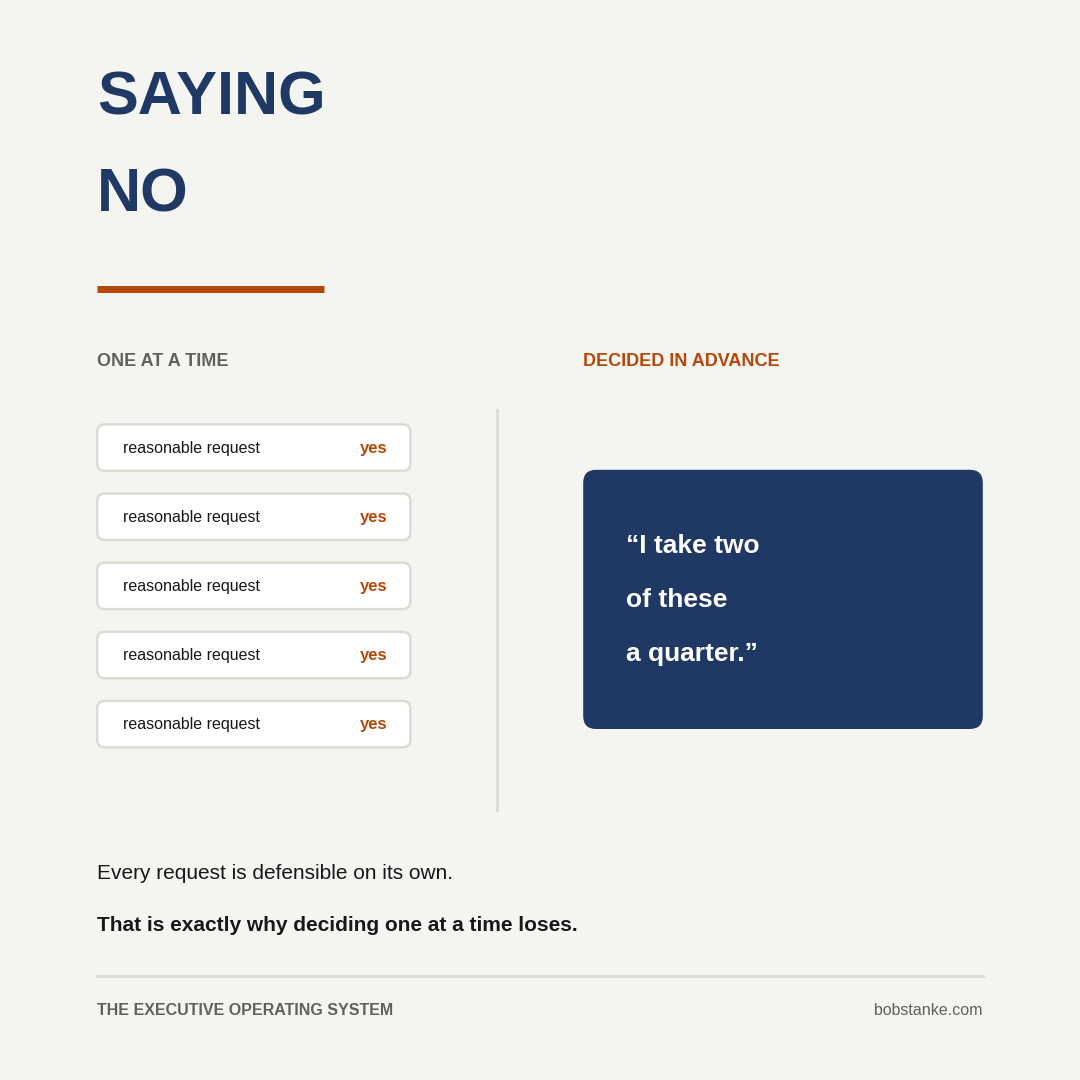
Here is the whole problem in one sentence: every individual request is defensible, and the aggregate is not. You evaluate them one at a time, because that is how they arrive. You never see the total at the moment you are deciding, because the total does not exist yet.
The arithmetic nobody runs
Say five requests reach you in a normal week. Not big projects, just asks. A call, a review, a quick look at something, an introduction.
Over 48 working weeks that is 240 requests a year.
Now assume you say yes to 80% of them, which is roughly what happens when you evaluate case by case and each case looks fine. That is 192 commitments. At an average of 45 minutes each, you have spent 144 hours, or about three and a half working weeks.
Getting more disciplined and dropping to 60% yes still leaves you 144 commitments and 108 hours.
Those inputs are illustrative rather than measured. Swap in your own numbers and the shape holds: the total is large, it is invisible while it accumulates, and no single decision inside it looks wrong.
The asymmetry that makes this structural
Every part of an operating system has a place where the costs and benefits sit with different people. Intake has two, and both of them push you toward yes.
Anyone can add to your intake. Only you can subtract from it. Adding takes one person thirty seconds. Removing takes a decision, a conversation, and someone's mild disappointment. The channel is wide going in and narrow coming out, and it stays that way unless you do something deliberate.
Declining has a visible cost and an invisible benefit. The person you decline knows they were declined, immediately and specifically. The benefit is diffuse, delayed, and lands mostly on work nobody is watching you not do. So at the moment of decision, the cost is concrete and the benefit is theoretical.
Put those together and the conclusion is uncomfortable but clean.
Deciding request by request means losing. Not because you are weak. Because the arithmetic at each individual decision point is genuinely stacked toward yes.
Which is why scripts do not work. A better sentence does not change the calculation. You are still standing in front of a reasonable request, alone, with the cost of no in front of you and the benefit of no somewhere over the horizon.
Decide once, in advance, at the category level
The only version of this that holds is deciding before the request arrives.
A rule moves the decision away from the moment of maximum pressure. When you are looking at a specific person with a specific reasonable ask, you are in the worst possible position to judge it. When you are looking at a category on a Tuesday morning with nobody in the room, you can see the aggregate.
That is the entire mechanism. Rules are not about discipline. They are about deciding at a moment when you can see the total.
The four kinds of rule
| Kind | What it sounds like | Best for |
|---|---|---|
| Capacity | "I take two of these per quarter" | Things you want to do sometimes, not always |
| Threshold | "Under $10k, decide without me" | Approvals and escalations |
| Category | "I do not take introductory calls" | Whole classes of request you never want |
| Default | "My default is no, and here is what earns a yes" | Anything genuinely varied |
Scroll the table sideways to see every column.
Capacity rules are the most useful and the least used, because the answer is not no, it is not now. That is a much easier thing to say and a much easier thing to hear.
Capacity rules are the most useful and the least used. They work because the answer is not no, it is not now, and that is a much easier thing to say. "I do two of these a quarter and both are taken. Ask me in January."
Threshold rules convert a stream of judgment calls into arithmetic. They are covered properly in mapping your decision rights, and they are the highest-yield rule most executives have never written down.
Category rules feel harsh and are the kindest of the four, because they are predictable. Nobody has to guess, and nobody takes it personally, because it was not about them.
Default rules are for the residue. Notice the second half: here is what earns a yes. A default of no without a stated exception is not a rule, it is a mood, and people will keep asking because they cannot tell what would work.
What to say when you decline
Short, because the rule is doing the work.
"I keep two slots a quarter for these and both are taken. Happy to look in January."
"That is below the line where I get involved. Sarah can approve it, and she does not need my sign-off."
"I do not sit in status meetings. Send me the notes and pull me in if a decision is stuck."
Notice what is missing. No apology, no justification, no invented conflict. You are not asking permission to decline. You are reporting a rule that already existed. That is why it lands without friction, and it is also why the script only works once the rule is real.
The part that actually decides whether this works
A rule you break twice is not a rule.
The first exception is usually correct. Something genuinely unusual arrives and the rule was not built for it. Fine.
The second exception is where it dies, because now everyone watching has learned the real rule: the stated rule holds unless you push. And pushing is free.
An inconsistent rule is worse than no rule, because it costs you the same to maintain and buys you nothing. You still have to explain it, people still have to test it, and it no longer changes anyone's behavior.
If you find yourself making a third exception, you do not have a discipline problem. You have the wrong rule, and the honest move is to change it out loud rather than keep breaking it quietly.
Where this sits in the operating system
Saying no is not a personality trait. It is the only mechanism by which anything leaves your intake, which is the first of the four components in the Executive Operating System: what reaches you, where your attention goes, what waits on your decision, what leaves your desk.
Intake comes first because everything downstream inherits its volume. An attention problem sitting on top of an unmanaged intake is not really an attention problem, and no amount of calendar work will fix it.
Two things worth reading next. How to stop executive information overload covers the channels and reports side, which is the same problem arriving through a different door. And the four meetings to cancel covers the commitments you already said yes to, since new rules do nothing about the backlog.
If you want to know whether Intake is actually your binding constraint or just the loudest one, the Executive Operating Index scores all four in about six minutes.
FAQ
How do I say no at work without damaging the relationship?
State a rule rather than a judgment about this request. "I keep two slots a quarter and both are taken" is not personal, so it does not land personally. Skip the apology and the invented conflict. You are reporting a rule that already existed, not asking permission to decline.
Why is it so hard to say no at work?
Because every request is defensible on its own, and you only ever see them one at a time. Declining also carries a visible cost and an invisible benefit, so at the moment of decision the downside is concrete and the upside is theoretical. The arithmetic favors yes.
What is a good rule for saying no?
Four kinds work: capacity rules that cap how many you take per quarter, threshold rules that set a dollar or scope line, category rules that decline a whole class of request, and default rules that state a no plus what earns a yes. Capacity rules are the most useful.
Should I explain why I am saying no?
Rarely, and briefly. A long justification invites negotiation, because it hands over reasons to argue with. A stated rule does not, since the rule was not created about this person. One sentence naming the rule is usually enough, and it is easier to say than a defense.
