The Four Meetings Every Executive Should Cancel This Week
Start with the arithmetic, because it is worse than it feels.
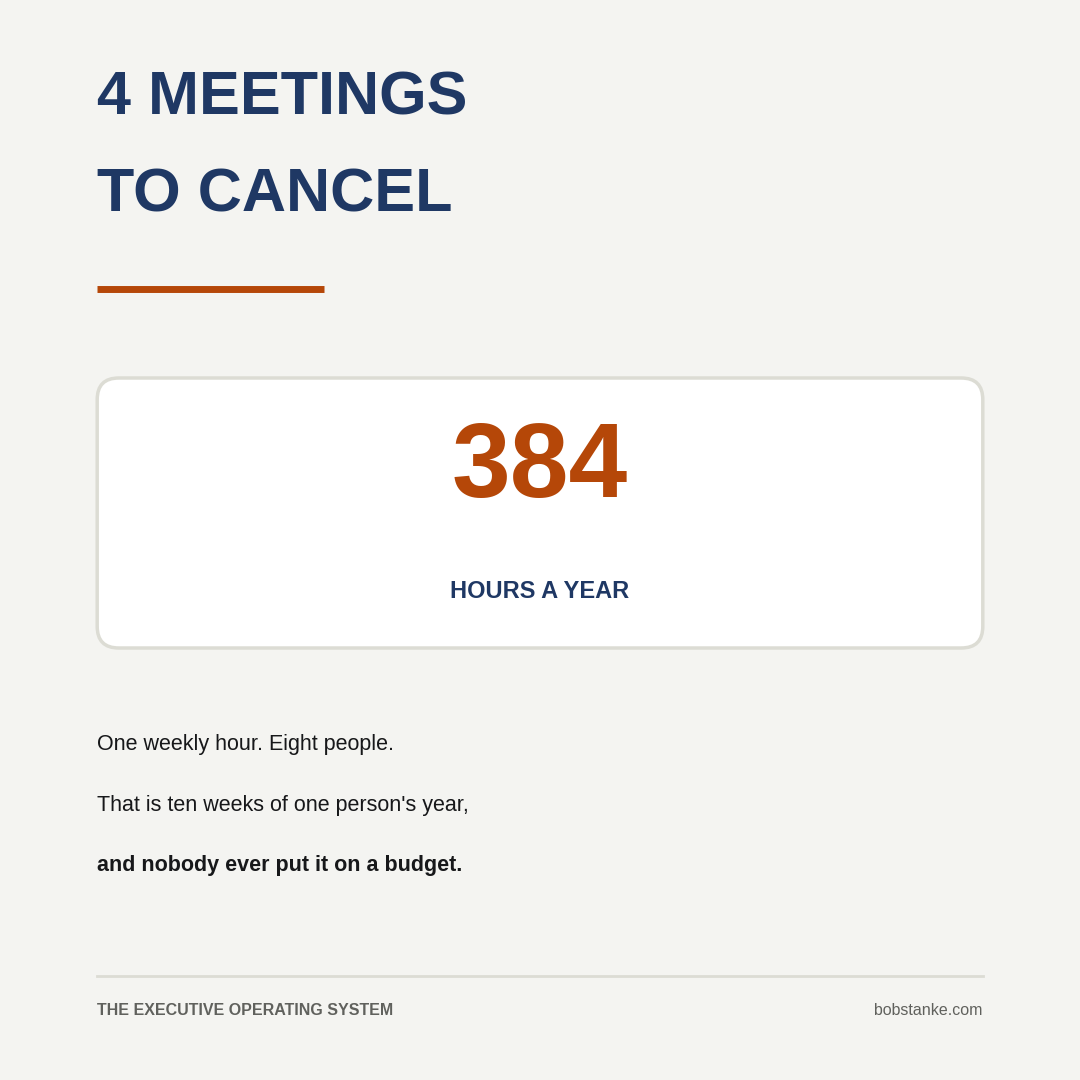
A recurring one-hour meeting with eight people, held weekly, consumes 384 hours a year. That is eight people times one hour times forty-eight weeks, allowing for holidays. Against a 1,920 hour working year, it is roughly ten weeks of one person's entire year.
One meeting. And nobody ever put it on a budget, because meeting time is the only significant company expense that never appears on a line item.
Here are four meetings worth looking at, with a test for each and something to actually say when you cancel them.
Why you have not already cancelled them
The reason is not laziness and it is not politics. It is structural, and it is the same asymmetry that governs everything else on your calendar.
Cancelling a meeting has a visible cost and an invisible benefit.
If you cut it and something goes wrong, everyone can see the cancellation and connect it to the failure. If you cut it and nothing goes wrong, nobody notices, because the eight hours a week that got returned do not arrive labeled. They just quietly become other work.
So the downside is attributable and the upside is anonymous. Every individual keeps every meeting, for reasons that are entirely rational at the individual level, and the calendar ratchets in one direction forever. I have written about this pattern in auditing your calendar, because it explains most of what is on yours.
The practical consequence: you cannot fix this by feeling more decisive. You have to change what it costs to try.
The four meeting worth cancelling
| The meeting | The test |
|---|---|
| The status meeting that is a document read aloud | Count the decisions made in the next one. If it is zero, and it was zero last time, you are distributing information the most expensive way available. |
| The meeting you attend but do not affect | Across the last three occurrences, did you say anything that changed what happened next? Not contributed. Changed. |
| The meeting that exists because a decision has no owner | Has this group discussed the same question more than twice without resolving it? The meeting is the symptom. Missing ownership is the cause. |
| The meeting that outlived its reason | Ask why it was created, not what it does now. If nobody in the room can name the originating event, the reason is gone. |
Scroll the table sideways to see both columns.
The last one is the easiest to cancel and the hardest to see. Recurring invites do not expire on their own.
1. The status meeting that is a document read aloud
What it is. Everyone reports what they did. Nobody decides anything. The value is real, in that people do end up informed, and the delivery mechanism is the most expensive one available.
The test. Sit through the next one and count the decisions made. Not discussions. Decisions, where something was true after that was not true before. If the count is zero and it was also zero last time, you are holding a meeting to distribute information.
What to say.
"Let's try these as written updates for three weeks. Post by Monday morning, I will read all of them, and we keep this slot free. If we lose something important we will put it back."
Why that phrasing. Three weeks and an explicit restore option. You are proposing an experiment rather than passing a verdict, which removes the political cost for everyone who privately values the meeting.
2. The meeting you attend but do not affect
What it is. A meeting that should absolutely happen, where your presence changes nothing. You attend because you were there last time, or because attendance feels like support.
The test. Think back across the last three occurrences. Did you say anything that changed what happened next? Not contributed. Changed. If you cannot point to something in three sessions, you are an expensive observer.
What to say.
"I do not think I am adding much here. Take me off the recurring invite, keep sending the notes, and pull me in when you need a decision."
Why this one is hardest. Executives read their own attendance as commitment, and worry that leaving signals the work does not matter. It usually signals the opposite. A team that can run a meeting without you has been told you trust them, which is worth more than the hour you were sitting in.
3. The meeting that exists because a decision has no owner
What it is. The same topic, discussed by the same group, repeatedly, without resolution. The meeting keeps getting scheduled because the thing is not settled, and the thing is not settled because nobody has been told it is theirs to settle.
The test. Has this group discussed the same question more than twice without a decision? If so, the meeting is not the problem. It is a symptom, and the missing piece is ownership.
What to say.
"Sarah owns this. Decision by the fourteenth, and she does not need consensus to make it. Let's take the recurring off the calendar and she will send the outcome."
Why cancelling actually works here. As long as the meeting exists, discussing it is a legitimate substitute for deciding it. Removing the forum removes the hiding place. This one belongs to a different component of the system, and mapping your decision rights is the underlying fix.
4. The meeting that outlived its reason
What it is. It was created for something specific. A migration, an integration, a launch, a crisis. That thing ended. The meeting did not.
The test. Ask the room why this meeting exists. Not what it does now, why it was created. If nobody present can name the originating event, or the people who could have left the company, the reason is gone.
What to say.
"This started during the platform migration, which finished in March. I am going to cancel it. If something breaks we will know within a month and we can bring it back."
The pattern worth noticing. These are the easiest to cancel and the hardest to see, because they have been on the calendar long enough to look like part of the furniture. Recurring invites do not expire. Somebody has to end them, and the person who created it usually is not thinking about it any more.
How to do it without it going badly
Cancel, do not shorten. Cutting an hour to thirty minutes keeps every attendee, every context switch, and the ratchet fully intact. It feels like progress and changes almost nothing.
Three weeks, with a stated restore option. Long enough to see consequences, short enough that nobody feels they lost an argument.
Say it is an experiment out loud. The point is not modesty. It converts cancelling from a judgment about someone's work into a test, which is the only version most people can accept without becoming defensive.
Then watch what actually breaks. Usually nothing does, which is information. Occasionally something does, and that is more useful still, because you have found out what the meeting was really for. That is worth knowing whether or not you restore it.
Do the arithmetic before you start. Attendees, times hours, times forty-eight. Write the number on the invite when you cancel it. People argue with opinions and rarely with multiplication.
What to do with the hours
A recovered hour that stays unclaimed gets absorbed within about two weeks. The calendar is not a vacuum and something will fill it.
So decide in advance. If you cancel two of these, put something in one of the slots on purpose and leave the other genuinely empty. Two hours to think covers why the empty one matters and why it is the first thing sacrificed.
Where this sits in the operating system
Meetings are the visible surface of the Attention component, the second of four in the Executive Operating System: what reaches you, where your attention goes, what waits on your decision, what leaves your desk.
Worth saying plainly though: three of the four meetings above are not really attention problems. The status meeting is an intake problem, the ownerless one is a decision problem, and the expired one is nobody's problem, which is why it survived. Attention is where the symptoms land. It is usually not where the cause lives.
If you want to know which component is actually binding for you, the Executive Operating Index takes about six minutes.
FAQ
How much does a recurring meeting actually cost?
A weekly one-hour meeting with eight people consumes 384 person-hours a year. Each attendee only gives up 48 hours, but the total the company spends equals what a full-time hire delivers in just under ten weeks. It is the largest expense most companies never put on a line item.
Which meetings should I cancel first?
Four kinds: the status meeting where no decision is ever made, the meeting you attend without affecting, the meeting that recurs because a decision has no owner, and the one created for a project that has since ended. The last is easiest to cut and hardest to notice.
How do I cancel a meeting without upsetting people?
Frame it as a three-week experiment with an explicit option to restore it. That converts the cancellation from a judgment about someone's work into a test, which most people accept without defensiveness. Then say what you will watch for, and mean it.
Why not just shorten meetings instead of cancelling them?
Shortening keeps every attendee, every context switch, and the underlying reason the meeting exists. It feels like progress and changes very little. If a meeting produces no decisions, thirty minutes of it produces no decisions faster.
