Why Your Team Feels Blocked
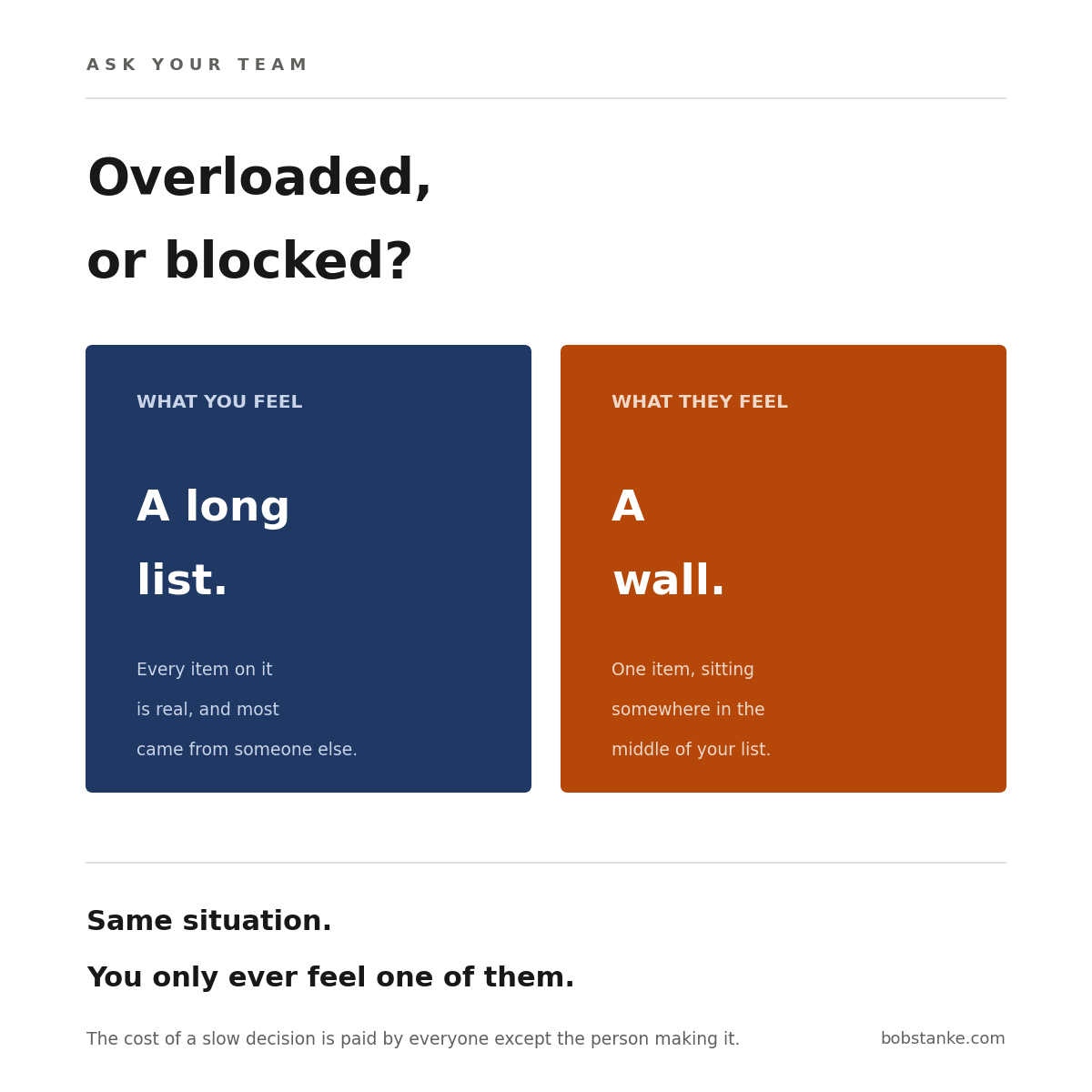
Ask your direct reports one question: do you feel overloaded, or do you feel blocked?
Overloaded means they have too much. Blocked means they are waiting.
If the answer is consistently blocked, and you have reasonable time on your calendar, then you are not overworked in the way you think you are. You are the queue, and the two feel nothing alike from where each of you is standing.
Two sensations, one cause
You experience a long list. Every item on it is real, most of them arrived from someone else, and getting through them feels like the job.
Your team experiences a wall. They cannot start, cannot finish, or cannot proceed, and the reason is one item sitting somewhere in the middle of your list.
Same situation. Completely different feeling. And you only ever have one of them, which is the reason this persists for years in organizations full of thoughtful people.
Why you never feel it
The cost of slow decisions is paid almost entirely by other people.
There is no report on your desk telling you how many days work waited for you. No dashboard shows decision latency. No one raises it in a review, because raising it means telling your boss they are slow, which nobody has ever been rewarded for.
How long decisions sit is one of the most expensive quantities in an organisation and one of the very few that nobody measures.
Compare it to anything else you manage. You know your headcount, your budget variance, your pipeline, your churn. You almost certainly could not say, within a week, how long the average decision waits on your desk. Neither could anyone else in your company, about theirs.
An unmeasured cost that lands on other people is a cost that gets ignored indefinitely.
What it actually looks like from their side
Five things happen in a team that is waiting, and none of them appear in any report you receive.
They stop starting work they cannot finish. If three things need your approval to complete, starting a fourth is irrational. So the team's throughput drops well before your decision queue is visibly long.
They batch their questions. Rather than ask you three times this week, they wait and ask once. Which means the first two questions sat unanswered for days, and neither of you experienced that as a delay.
They guess. Sometimes correctly, which trains them to keep guessing. Sometimes incorrectly, which produces rework that arrives on your desk looking like a competence problem rather than a latency problem.
They lose the thread. Work paused for two weeks costs more than two weeks, because reloading the context is expensive and some of it never comes back.
They look slow to their own teams. Your delay becomes their credibility problem one layer further down, and they absorb that quietly because complaining about it upward is unattractive.
The three things causing it
Ambiguity escalates, and it always escalates upward
When ownership of a decision is unclear, it comes to you.
Look at it from two levels down. Deciding and being wrong is a story about them overstepping. Escalating carries no personal risk and looks conscientious. So the individually rational move is always to send it up, and every unclear boundary produces a steady stream of decisions that never needed you.
Nobody is doing anything wrong. The system has a default, and the default is your desk.
"Let me think about it" is more expensive than "no"
This is the least intuitive of the three and probably the most useful.
A decline unblocks. The person hears no, drops it or finds another route, and moves on the same day. It stings and it costs almost nothing.
A deferral blocks indefinitely. They cannot plan around it, cannot escalate past it, and cannot honestly tell anyone downstream when it will resolve. So they wait, and the item sits in both of your heads consuming attention without producing anything.
The kindest thing you can do with a decision you are not going to prioritise is decline it today. Most senior leaders defer instead, because deferral feels considerate and declining feels harsh. From the other side, the ranking is exactly reversed.
Reversible decisions get irreversible-decision scrutiny
Some decisions are one-way doors. Get them wrong and you live with it for years, so they deserve real deliberation.
Most are two-way doors. You can undo them in a week at modest cost.
The expensive failure is applying the first standard to the second category. And the cost is not the time you spent thinking. It is the queue that formed behind you while you did.
The compounding you are not seeing
A decision that waits ten days does not cost ten days.
It costs ten days multiplied by everyone whose work depends on it. Then it costs the restart tax when they reload the context. Then it costs the credibility of anyone who told a customer or a colleague that this would be resolved by now.
And underneath all of that sits the most expensive item, which is the one nobody names.
When decisions reliably sit, people stop treating them as things that will happen. They stop building on them. They stop planning around them. They hedge, and they keep alternatives alive, and every one of those hedges costs something.
That is also why reopening decisions is so corrosive. A decision that can be reopened is not a decision. It is an opinion with a timestamp, and teams correctly stop building on opinions.
What to do about it
Four moves, roughly in order of how quickly they pay back.
Write down what does not need you. Four or five lines. Something reaches you if it crosses a spending number you name, affects a named customer or partner, sets a precedent, cannot be reversed, or crosses into another team's area. Everything else gets decided below you and reported afterward rather than before. The full method is here, and it costs about an hour.
Decide the reversible ones immediately, in the room. If it can be undone in a week, make the call while the person is still in front of you. The quality loss is small and usually imaginary. The latency saving is enormous.
Replace deferral with a decline or a date. Not "let me think about it." Either no, or a specific day. A date is a commitment they can plan around. An open-ended maybe is not.
Measure it for two weeks. Keep a running list: what arrived, when, and when you decided. Two weeks is enough to produce a median. Almost nobody knows this number about themselves, and seeing it is usually more persuasive than any argument.
If most of what is waiting turns out to be things someone else could have decided, that is a decision rights problem. If most of it is genuinely yours and there is simply too much of it, the constraint is probably further upstream in what reaches you at all.
Is this actually your constraint?
The signature is specific, and it is worth separating from the components either side of it.
It is Decisions if you have reasonable time available, your inflow is manageable, and work still sits. Your team says blocked rather than swamped. Things move quickly again the moment you clear a backlog, and then slow down again a fortnight later.
It is Attention if your week is so fragmented that you never reach the decisions at all. The queue exists because you have no uninterrupted time to work through it, not because you are hesitating.
It is Intake if the volume of things requiring a decision is itself the problem. You are deciding quickly and there are simply too many, which means the filter upstream is missing.
It is Distribution if the work waiting on you is work that should not have been yours in the first place. That is a delegation problem wearing a decision problem's clothes.
Those four look nearly identical from the inside, which is why most people guess wrong about their own. The Executive Operating Index scores all four in about five minutes and names the one actually binding. It is free, and your score appears before you are asked for anything.
The question worth asking this week
Go back to the first line of this article and actually ask it.
Not in a survey. In a one to one, out loud, and then be quiet long enough for a real answer.
Do you feel overloaded, or do you feel blocked?
Most senior leaders have never asked, which means most of them have a number sitting in their organization that they have never seen and are paying for every week.
FAQ
How do I know if I am the bottleneck? Ask your directs whether they feel overloaded or blocked. Overloaded means too much work. Blocked means waiting on someone, usually you. If the answer is consistently blocked while you have time on your calendar, you are the queue.
Why does my team wait instead of deciding? Because deciding carries personal risk for them and asking carries none. Where ownership is unclear, escalating is always the individually rational choice, and it looks conscientious rather than cautious.
What is decision latency? The time between a decision reaching someone and being made. It is one of the most expensive quantities in an organization and one of the very few nobody measures, largely because the cost lands on people other than the decider.
Is it better to say no or to say let me think about it? Usually no. A decline unblocks immediately. A deferral blocks indefinitely and cannot be planned around. If you are not going to prioritize something, declining it today is more useful to everyone than deferring it kindly.
How fast should decisions be made? Reversible ones should be made in days and often in minutes. Irreversible ones deserve real deliberation. The common failure is not being slow overall, it is applying the same speed to both kinds.
How do I measure how long decisions sit? Keep a two week log: what arrived, when it arrived, and when you decided. That produces a median, a count of anything still open, and a clear view of how much of it someone else could have handled.
Bob Stanke is a Chief of Staff and Executive Advisor. He writes about the operating layer of executive work: what reaches you, where your attention goes, how decisions clear, and what leaves your desk.
