How to Delegate as a Leader
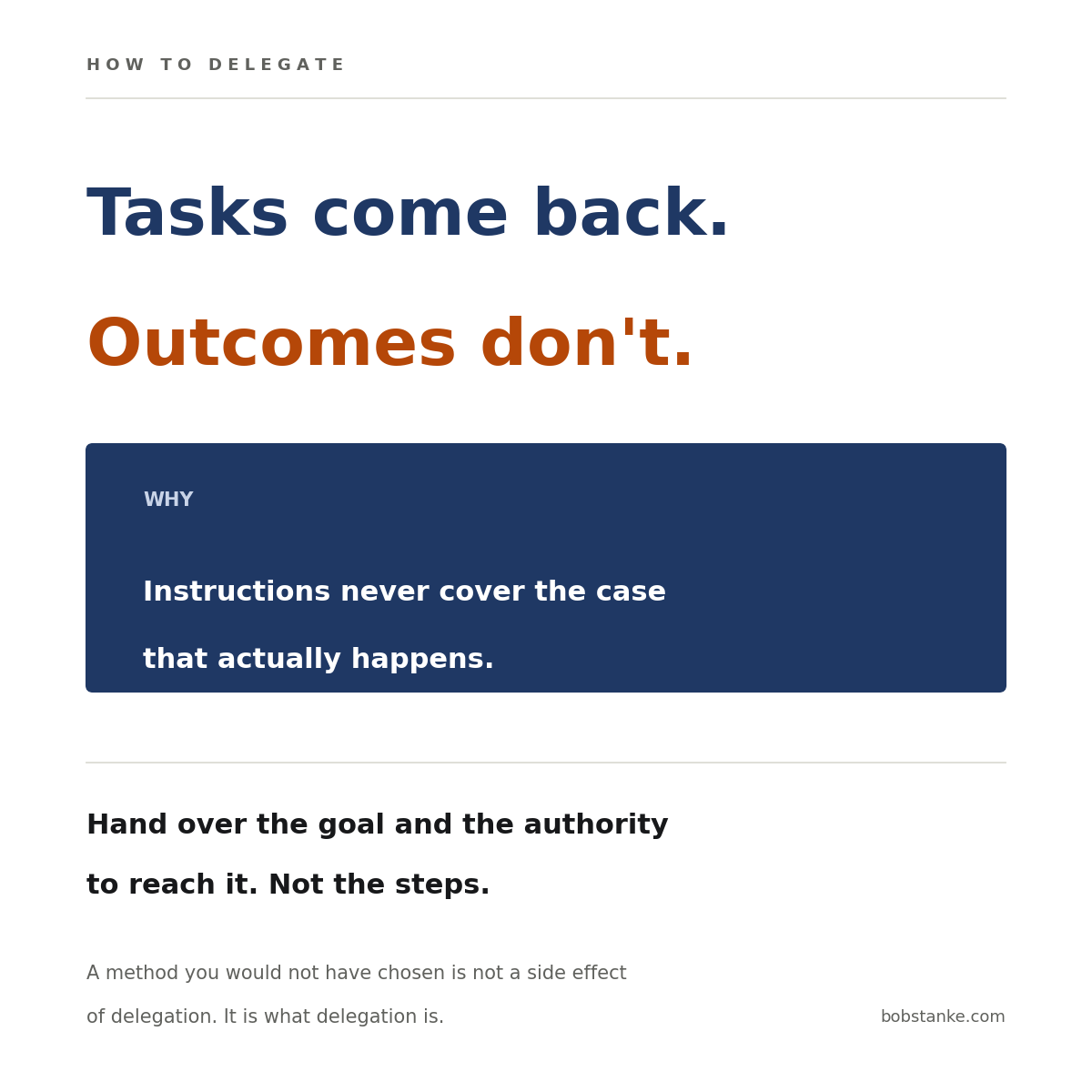
Delegation fails for mechanical reasons, not for reasons of willingness. Most advice on it treats the problem as psychological: you need to let go, trust your team, get comfortable with imperfection. That framing is why so many people read the advice, agree with it, try again, and watch the same work return within a month.
The work comes back because of how it was handed over. Here is what actually goes wrong, and what to do differently.
Why it comes back: five mechanisms
1. You handed over a task, not an outcome.
Tasks arrive with instructions. Instructions never cover the case that actually happens, and when the person hits the gap, the only move available to them is to return to you. You experience this as the work bouncing. They experience it as doing what they were told.
2. You handed over the work but not the authority.
They can do it. They cannot decide about it. So every judgment call comes back, and since most work is mostly judgment calls, most of it comes back. This is the most common version and the hardest to see, because on paper the delegation looks complete. If work comes back with the authority attached to you, this is why.
3. You corrected the method.
They reached the outcome by a route you would not have chosen, and you told them so. Reasonably, kindly, in passing. They now understand that they own the execution but not the judgment, which means they own neither, which means the next ambiguous moment arrives on your desk.
4. You never actually left the loop.
Still copied on the thread. Still in the weekly meeting. Still the person the customer emails. Delegation that leaves you mechanically present is supervision with extra steps, and everyone involved can tell.
5. The capability genuinely is not there yet.
Sometimes this is the real answer. It is also the one people reach for first, because it locates the problem in someone else. Worth taking seriously only after the other four have been ruled out.
The distinction that matters most
Delegating a task means handing over instructions. Delegating an outcome means handing over the goal and the authority to reach it.
The test is not whether it went out cleanly. It is whether it came back.
Consider the difference in practice. "Put together the vendor comparison, use the template, include the three we shortlisted, have it to me Thursday" is a task. The person will do exactly that, and when they discover a fourth vendor worth considering, or that the template does not fit, they will ask you.
"You own the vendor decision. Budget is capped at this number, it needs to be signed by end of quarter, and I want to know before we commit to anything over two years" is an outcome. The fourth vendor is now their call. So is the template.
The second version costs you more upfront and less thereafter. Which is exactly the trade most senior leaders decline to make when they are busy, and being busy is precisely when they need to make it.
The two forces working against you
Neither of these is a character flaw, and both operate whether or not you notice them.
You are widening the gap you use to justify holding the work
"It is faster if I do it" is almost always true. It is also a statement about the past rather than a reason about the future.
The reason you are faster is that you have always done it. Every instance you keep makes you marginally faster and leaves your team exactly where they were. The gap between your speed and theirs is not a fixed fact you discovered. It is something you are actively widening, one sensible decision at a time.
Which means the cost of handing something over only ever rises. The handoff you skip this quarter because you are busy will take longer next year, because by then the distance will be greater and the work will have absorbed more of your particular habits.
Delegation is judged by its failures and never by its successes
This is the quieter of the two and it explains why people stop trying.
When delegation works, nothing happens. The work gets done, on time, by someone else, and it produces no event. Nobody congratulates you. You do not even remember it.
When delegation fails, it produces a highly visible event with a clean causal story attached: I should not have handed that off.
So your felt experience of delegation is systematically biased toward failure, no matter what the actual base rate is. Ten quiet successes and one loud failure feels like evidence that delegation does not work here. It is not evidence of anything except how memory works.
Four kinds of things you are holding
Before you can hand work over, it helps to know what type of hold you have on it, because each type has a different fix and most people reach for the wrong one.
Knowledge. Only you know how it works, where it lives, or why it was built that way. The fix is documentation. Not a polished runbook. One page that lets a competent person start.
Authority. Only you can approve it. Nothing about the work requires you, only the permission does. The fix is written decision rights. Documentation does nothing here. If the person still has to wait for you to say yes, writing down how you would decide has changed nothing.
Relationship. Only you have the relationship. A key customer, a board member, a counterpart who will only take your call. The fix is a deliberate second introduction, made while nothing is wrong. Introducing someone during a crisis reads as escalation. Introducing them in a quiet quarter reads as normal.
Access. Only you have the credential, the login, the seat, the signing authority. The fix is provisioning, and it is usually the fastest item on any list. It is also the one most likely to still be unresolved a year from now, because nobody's job is to notice it.
Most executives assume everything on their plate is a knowledge problem and reach for documentation. Sort the list first. A runbook cannot make a customer trust someone new.
How to actually hand something off
Six steps. The first three take ten minutes and determine everything.
1. Name the outcome, not the activity. What has to be true when this is finished. Not what has to be done.
2. Name the authority explicitly. What they can decide without asking you. Be specific, because vagueness here defaults to asking, every time. Silence is not permission and your team knows it.
3. Name the constraints. Budget, deadline, what is genuinely off limits. Three or four lines. This is what makes the authority safe to exercise rather than frightening.
4. Agree how you will hear about it. Not whether you will be involved, which invites you back in, but the shape of reporting. A line in the weekly. A note when it lands. Something specific enough that neither of you has to guess.
5. Remove yourself mechanically. Come off the email thread. Leave the recurring meeting. Redirect the person who always asks you. Delegation that leaves you in the room is not delegation, and this is the step almost everyone skips because it feels like abandonment rather than completion.
6. Let the first one be done differently. Covered below, because it is where most of this comes undone.
The moment it dies
At some point in the first month, the person will reach the outcome you asked for by a route you would not have chosen.
What you do next determines whether any of this holds.
If you correct the method, you have taken the work back without saying so. They now understand they own the result and also the process, which means they own neither, and the next ambiguous moment comes to you. Nothing about this requires you to be harsh. A mild "next time, maybe try it this way" does it perfectly.
If you let the method stand and engage only where the outcome actually missed, the handoff survives. You will find this harder than it sounds, particularly for work you used to do well.
Delegating an outcome means accepting a method you would not have chosen. That is not a side effect of delegation. That is what delegation is.
When delegation is not the answer
Three situations where more delegation makes things worse, and honesty is more useful than encouragement.
There is genuinely nobody to delegate to. Small teams, founders, functional leaders with two or three reports. If the capacity does not exist, no amount of better handoff technique creates it. The only remaining lever is subtraction: doing fewer things, which is a scope decision rather than a delegation one.
The capability gap is real. If the person cannot yet carry the work, delegating it produces a bad outcome and a damaged confidence. That is a development problem, and closing it is your job rather than a reason to route around it. Worth checking honestly whether the gap is real or simply untested.
The work actually requires you. Some of it does. Judgment calls that depend on context only you have, relationships that cannot be transferred quickly, decisions where your specific authority is the point. Naming these clearly is useful, because it lets you stop feeling guilty about them and focus on the rest.
The number to watch
One question, and it is more informative than any amount of reflection.
What would stop entirely if you were unavailable for a week starting tomorrow, with no notice?
Not a planned holiday. Planned absence hides this, because you prepare for it. You write the handover, you pre-approve what you know is coming, you tell three people what to watch. That preparation is exactly the work that conceals what would otherwise break.
Write the list. For most senior leaders it runs to between four and ten items, and about half of them are surprises. Each one is a single point of failure with a name attached, and the list is usually shorter and more fixable than it feels.
If you want this scored properly alongside the other three components of how you operate, the Executive Operating Index takes about five minutes and tells you whether delegation is actually your constraint or a symptom of something further upstream. It is free, and your score appears before you are asked for anything.
One last thing
Your delegation is also your team's ceiling.
Whatever you hold, they never learn. The person who could have grown into that work stays where they are, and after a while the strong ones notice that the interesting problems never reach them.
Good people rarely leave because of workload. They leave because the work stopped teaching them anything. A leader who holds too much produces that outcome reliably and almost never sees the connection, because the resignation conversation is always about something else.
FAQ
Why does delegated work keep coming back to me? Usually because a task was handed over rather than an outcome, or because the work was delegated without the authority to make decisions about it. Both produce the same symptom, which is the person returning at the first case the instructions did not cover.
What is the difference between delegating tasks and outcomes? A task comes with instructions and a defined activity. An outcome comes with a goal, the authority to reach it, and stated constraints. Tasks come back because instructions are always incomplete. Outcomes do not, because the person can handle the unexpected case themselves.
How do I delegate when I do not trust my team yet? Start with reversible work where a wrong answer is cheap, and be explicit about the authority rather than implying it. Trust is built by watching people decide, which requires letting them decide first.
What if I have nobody to delegate to? Then delegation is not your lever and better technique will not help. The remaining option is subtraction: deciding what you are going to stop doing. That is a scope decision rather than a delegation one, and it is the honest answer for small teams.
How do I stop taking work back? Notice the moment you correct a method rather than an outcome. That single move, however gently done, transfers the process back to you and takes the judgment with it.
How much should a senior leader delegate? A useful test rather than a percentage: if you disappeared for a week with no notice, no more than one or two things should stop entirely. Most senior leaders find between four and ten.
Bob Stanke is a Chief of Staff and Executive Advisor. He writes about the operating layer of executive work: what reaches you, where your attention goes, how decisions clear, and what leaves your desk.
