Map Your Decision Rights

Decision rights are the written answer to a simple question: which decisions require you, and which do not. Mapping them means putting that answer on paper, at a level of specificity your team can actually apply without checking.
Most organizations have never done this. They have an org chart, which describes reporting, and they assume it also describes deciding. It does not.
NOTE: If you would rather skip right to the artifact, here is a template you can fill in today that will help you document your decision rights.
Why do decisions pile up on your desk?
There is a structural reason, and it is not that your team lacks judgment.
When ownership of a decision is unclear, the decision escalates.
Look at it from the position of someone two levels below you. They face a call that might be theirs. If they decide it and they are right, almost nothing happens. If they decide it and they are wrong, it becomes a story about them overstepping. If they escalate it, they carry no risk at all, and escalating even looks conscientious.
So the individually rational move is always to send it up. Ambiguity has a direction, and the direction is toward you.
This compounds quietly. Every unclear boundary produces a small stream of decisions that did not need you, and each one arrives looking perfectly reasonable in isolation. Nobody is doing anything wrong. The system simply has a default, and the default is your desk.
The cost you cannot see
Here is why this persists longer than it should: the cost of slow decisions is paid almost entirely by other people.
You experience a full calendar and a long list. Your team experiences being blocked, which is a completely different feeling and one you never have. There is no report on your desk that says how many days work sat waiting for you. Decision latency is one of the most expensive quantities in an organization and one of the very few that nobody measures.
A useful sign: ask your directs whether they feel overloaded or blocked. Overloaded means they have too much. Blocked means they are waiting. If the answer is consistently blocked, and you have reasonable time on your calendar, the constraint is here rather than in your schedule.
How to map your decision rights
You do not need a workshop or a consultant for this. You need about ninety minutes and honesty about the last few weeks.
1. List the last twenty decisions that reached you
Pull them from your calendar, your sent mail, and memory. Do not filter for the interesting ones. Small approvals count, and they are usually where the pattern shows up.
2. Annotate each one
Four columns:
Who else could have decided this? Write a name. The instinct is to write "only me." Sometimes that is true. Often the honest answer is that someone else could have decided, but you would have wanted to know, or you were not confident they would land where you would. Those are different problems and neither is the same as "only me."
Was it reversible? Could you undo it in a week at modest cost, or not?
How long did it sit? From when it first reached you to when you decided.
What was it waiting on? Information, another person, or your attention.
3. Read the pattern
Three numbers come out of this, and they tend to be uncomfortable.
The percentage where you wrote a name rather than "only me" is the share of your decision load that did not need you. Under twenty five percent is healthy. Half is common.
The median days a decision sat is your latency. Under five days is healthy.
And the count of reversible decisions that took more than a week tells you how much one way door rigor you are applying to two way doors.
4. Sort into four levels
Every recurring decision type in your area belongs in one of these:
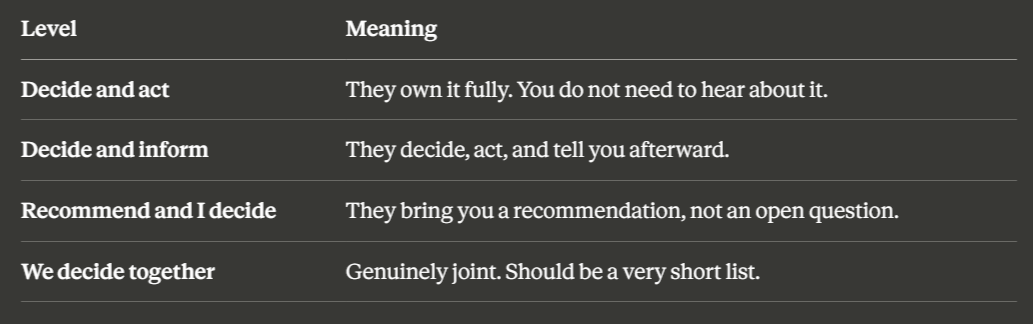
Most organizations run almost everything at level three by default, without anyone choosing that. Moving even a few recurring categories up to levels one and two is where the time comes back.
5. Write the thresholds
Levels are useless without criteria. Something reaches you if it:
exceeds a spending number you name explicitly
affects a named customer, partner, or regulator
sets a precedent that will be cited later
cannot be reversed, or would be expensive to reverse
crosses into another team's area
Four or five lines is enough. This is the same logic as escalation criteria in your intake, and that overlap is not accidental. Escalation is where decisions and intake meet.
The specific numbers matter far less than their existence. Written criteria let people filter themselves, which is the only kind of filtering that scales. If volume itself is the problem, I have written an article about decision fatigue that covers where that comes from.
6. Publish it and invite people to test it
Send the map to your team. Ask them to tell you when something they brought you should have been theirs, and when something they decided should have come to you. Both directions are useful, and asking for the second one makes the first one safe to say.
The moment the map lives or dies
At some point in the first month, someone will decide something at their new level and get it partly wrong.
What you do in that moment determines whether any of this survives.
If you take the decision back, or express visible frustration, or start asking to see that category again, everyone learns the map was decorative. The escalation default returns immediately, and it returns stronger, because now there is evidence.
If you back the decision publicly and work the correction privately, the map holds. The cost is one imperfect outcome. The return is that every similar decision for the next two years happens without you.
That trade is almost always worth taking, and it is almost always harder in the moment than it looks on paper.
A decision that can be reopened was never a decision
One more failure mode, and it is the quietest.
If decisions in your area get relitigated, people stop treating them as settled. Work slows down not because anyone is waiting on you but because nobody is confident the ground will stay where it is. Why build on a decision that might be revisited next month?
A decision that can be reopened is not a decision. It is an opinion with a timestamp.
Reopening should require new information, and saying so out loud costs you nothing. "We are not reopening this unless something changed" is a complete sentence, and it is worth more than most process improvements.
How to tell if Decisions is your constraint
The signature is specific, and it is worth distinguishing from the two components on either side of it.
If work sits while you have reasonable time available, and your team describes itself as waiting rather than swamped, and things move quickly again the moment you clear a backlog, the constraint is here.
If instead your calendar is so fragmented that you never reach the decisions at all, the constraint is upstream in your attention, or further upstream in what is reaching you in the first place. Slow decisions are a symptom of both, which is why it is worth checking the order before you start fixing things.
FAQ
What are decision rights? The explicit assignment of which decisions belong to which role. Distinct from an org chart, which describes who reports to whom and says nothing about who decides what.
How is this different from RACI? RACI maps roles across a project or process. Decision rights map authority across recurring decision types, and they are written from the perspective of what someone can do without asking. RACI is broader and heavier. This is narrower and faster.
How long should a decision take? Reversible decisions should be made in days and often in minutes. Irreversible ones deserve real deliberation. The common failure is not being too slow overall, it is applying the same speed to both kinds.
What if I do not trust my team to decide? Then that is the actual problem, and decision rights will not fix it. Either the capability gap is real, in which case it is yours to close, or it is not real and you are paying a large tax on a belief you have not tested.
How often should I revisit the map? Once or twice a year, and whenever the team structure changes. It should be a living document that people cite, not a document that gets written once and filed.
Bob Stanke is a Chief of Staff, the role companies create when an executive's operating system has outgrown them. He writes about the operating layer of executive work: what reaches you, where your attention goes, how decisions clear, and what leaves your desk.
The Executive Operating Index scores all four components in about five minutes and tells you which one is actually binding. Take the assessment.
