Managing Managers: The Moment You Stopped Seeing the Work
Your managers are good. Your one-on-ones happen. Your reports are current and your dashboards are green.
And you are being surprised by problems more often than you were two years ago, when you had less help and saw more of what was going on.
That is not a people problem, and another status meeting will not fix it. Something structural changed when your direct reports became managers, and almost nobody names it out loud.
What actually changed
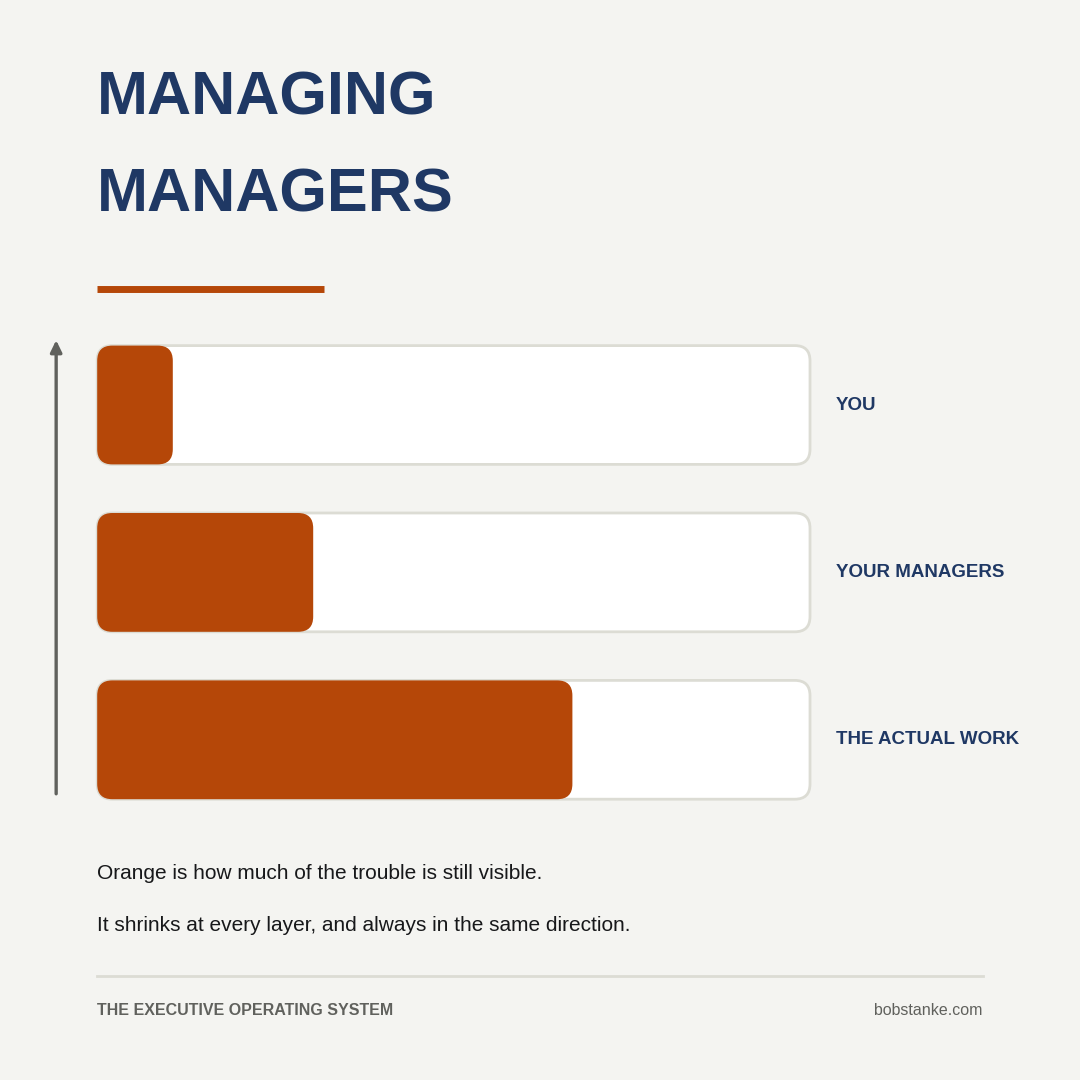
You stopped seeing work. You started seeing descriptions of work.
When your reports were individual contributors, you had access to the raw material. You could open the document, read the code, sit in on the call, look at the actual numbers. Your judgment was applied to primary sources, and when something looked wrong you usually noticed it yourself.
Now every piece of information about your organization reaches you having passed through at least one person whose performance you are also evaluating.
That last part is the uncomfortable bit. The person telling you how their area is going is the same person who gets judged on how their area is going. This is not a character flaw in your managers. It is the structure of the job you gave them.
The comparison, in one table
| Managing individual contributors | Managing managers | |
|---|---|---|
| What you see | The work itself | Descriptions of the work |
| How you improve output | Fix the work | Improve the judgment behind it |
| Feedback loop | Days | Weeks, sometimes a quarter |
| Quality control | Inspection | Sampling and calibration |
| Your main risk | Micromanaging | Being surprised |
Scroll the table sideways to see both columns.
Most advice about managing managers addresses the old risk. Once your reports manage people, being blindsided is the likelier failure.
Most advice about managing managers is aimed at the bottom left box. Stop micromanaging, trust your people, give them room. That advice is fine and it is solving last year's problem. Your risk has moved. You are now far more likely to be blindsided than to be meddling.
Why your picture drifts optimistic
Here is the mechanism, and it is worth being precise about it because the fix follows directly from it.
Nobody lies to you. What happens is smaller and much harder to see.
Every status update involves a choice about how to characterize something genuinely ambiguous. Is the project late, or is it tracking to a revised timeline? Is the customer unhappy, or are they engaged in a detailed conversation about their requirements? Is that engineer struggling, or ramping?
In each pair, both descriptions can be honestly defended. One of them generates follow-up questions and one does not.
So there is a mild, rational, entirely understandable pull toward the second description. Not a lie. A rounding.
Now add a layer. Your manager rounds up slightly when they talk to you. But the person who briefed your manager had already rounded up slightly before that conversation happened. The two roundings point the same direction, so they do not cancel out. They stack.
Some illustrative arithmetic. If each layer presents things as roughly 15% more under control than they are, two layers gets you to about 32% rosier than reality. Three layers, close to 50%. Those percentages are made up to show a shape rather than to measure anything real, and the shape is the point: the distortion is multiplicative, not additive, and it always runs the same direction.
You are not getting a distorted picture because your managers are dishonest. You are getting a distorted picture because you built a system where the honest version costs more to deliver than the optimistic one, then staffed it with reasonable people who noticed.
Three fixes that do not work
More status reporting. This increases the volume of the signal without improving its quality. You will get more of exactly the thing that is already misleading you, and you will spend more of your week reading it.
Going around your managers. This works, which is why it is tempting, and it carries a real cost. Every time you get information by routing around a manager, you spend a little of that manager's authority to buy it. Do it occasionally and by design and it is cheap. Do it reactively whenever you feel uneasy and your managers will correctly conclude that you do not trust them, which makes the reporting problem worse rather than better.
Trusting your instincts. Your instincts were trained on data you no longer receive. The pattern recognition that made you good at the previous job was built from direct exposure to the work, and it degrades quietly once that exposure stops. It does not feel like it is degrading. That is the problem with it.
Five things that actually work
1. Ask what they decided, not how it is going.
"How is it going" invites a summary, and summaries are where the rounding happens. Try "what did you decide this week, and what are you still deciding?" instead. Decisions are specific, they are hard to round, and the second half of the question gives a manager a socially easy way to surface something stuck without having to frame it as a problem.
2. Sample one real artifact per area per month.
Not a summary. The actual thing. One real customer complaint, one actual pull request, one live support ticket, the real spreadsheet rather than the slide about the spreadsheet.
This is the direct antidote to compounding optimism, because it gives you one ground-truth reading to calibrate the summaries against. You are not inspecting the work and you are not looking for something wrong. You are checking whether the description you have been given matches the thing it describes.
Once a month, per area, is enough. This is sampling, not supervision, and the difference should be visible to your managers.
3. Make the first bad news of any cycle visibly cheap.
When a manager brings you a problem, your next sentence sets the price of the next problem they find. If it is "how did this happen," you have just made the honest version expensive, and you will hear about the following one later than you would like.
Try "what do you need" first. Get the diagnosis later, in a separate conversation, once the thing is contained.
4. Run skip-levels on a schedule, not on a hunch.
A skip-level that happens because you are worried announces that you are worried. A skip-level that happens because it is the second Tuesday of the month announces nothing at all.
Tell your managers the schedule in advance, tell them what you will ask, and never act on something from a skip-level without routing it back through the manager first. That last rule is what keeps the practice from costing you the authority you are trying to preserve.
5. Watch which managers never escalate.
Keep a rough count of what each manager brings you. Not to score them. To notice the shape.
A manager who has escalated nothing in ninety days is not a manager without problems. Every area has problems. An area reporting none is reporting badly, and the two likeliest explanations are that they are handling things you would want to know about, or that they have learned escalation is expensive here.
The manager who needs help most asks for it least. Strong managers escalate because they are confident it is safe. Struggling managers go quiet, which means your attention flows toward the people who need it least, exactly when it is needed elsewhere.
The asymmetry
Every part of an operating system has one of these: a place where the cost and the benefit do not land on the same person.
Here it is. Delivering bad news costs the messenger immediately and benefits you later.
Your manager pays now, in scrutiny, in follow-up questions, in a harder conversation than the one they were going to have. You collect later, in early warning and in the time to do something about it. Both of you are behaving reasonably. The incentive is simply misaligned in time and across people.
Which leads to the part that matters:
Only you can change the price of bad news. Your managers cannot lower it for themselves. Anyone below them has even less influence over it. You set that price, mostly through small reactions you are not tracking, and the quality of everything you know about your organization follows from where you set it.
That is not a soft skill sitting alongside the job. For a manager of managers, it is most of the job.
Where this sits in the operating system
It is tempting to file this under people management. It belongs under Intake.
The four components of the Executive Operating System run in order: what reaches you, where your attention goes, what waits on your decision, what leaves your desk. Intake comes first because everything downstream inherits its quality. Decisions made on rounded-up information are rounded-up decisions, however good your decision process is.
When you started managing managers, your intake changed from primary sources to filtered ones, and most people never adjust for it. They keep running the attention and decision habits that worked when they could see the work, on top of an information layer that no longer behaves the same way.
Two adjacent pieces worth reading next. Mapping your decision rights covers what should reach you at all, which is the other half of this problem. And delegating so work does not come back handles the downward direction, where this post has been about what comes back up.
If you want to know where your own constraint sits, the Executive Operating Index takes about six minutes.
FAQ
What is the difference between managing managers and managing individual contributors? You stop seeing the work and start seeing descriptions of the work. Your leverage moves from fixing output to improving the judgment that produces it, your feedback loop stretches from days to weeks, and your main risk changes from micromanaging to being surprised.
Why do I keep getting surprised by problems in my organization? Because optimism compounds through layers. Every status update involves characterizing something ambiguous, and there is a mild rational pull toward the reading that generates fewer follow-up questions. Those roundings run the same direction at every layer, so they stack rather than cancel.
How often should I do skip-level meetings? Monthly or quarterly, on a fixed schedule known in advance. A scheduled skip-level gathers information. An unscheduled one announces that you are worried, and costs your manager authority you will want them to have.
Should I worry about a manager who never escalates anything? Yes. Every area has problems, so an area reporting none is reporting badly. The usual explanations are that they are absorbing things you would want to know about, or that they have learned escalation is expensive. Both are worth a conversation.
