The Chief of Staff Job Description That Does Not Produce the Wrong Hire
You have decided to hire a Chief of Staff. Now you have to write the posting, and this is where most of these hires go wrong.
Not at the interview. Not at the offer. At the job description, because the document you write determines who applies, and most of these documents quietly advertise a different job than the one you need.
Why most of them produce the wrong hire
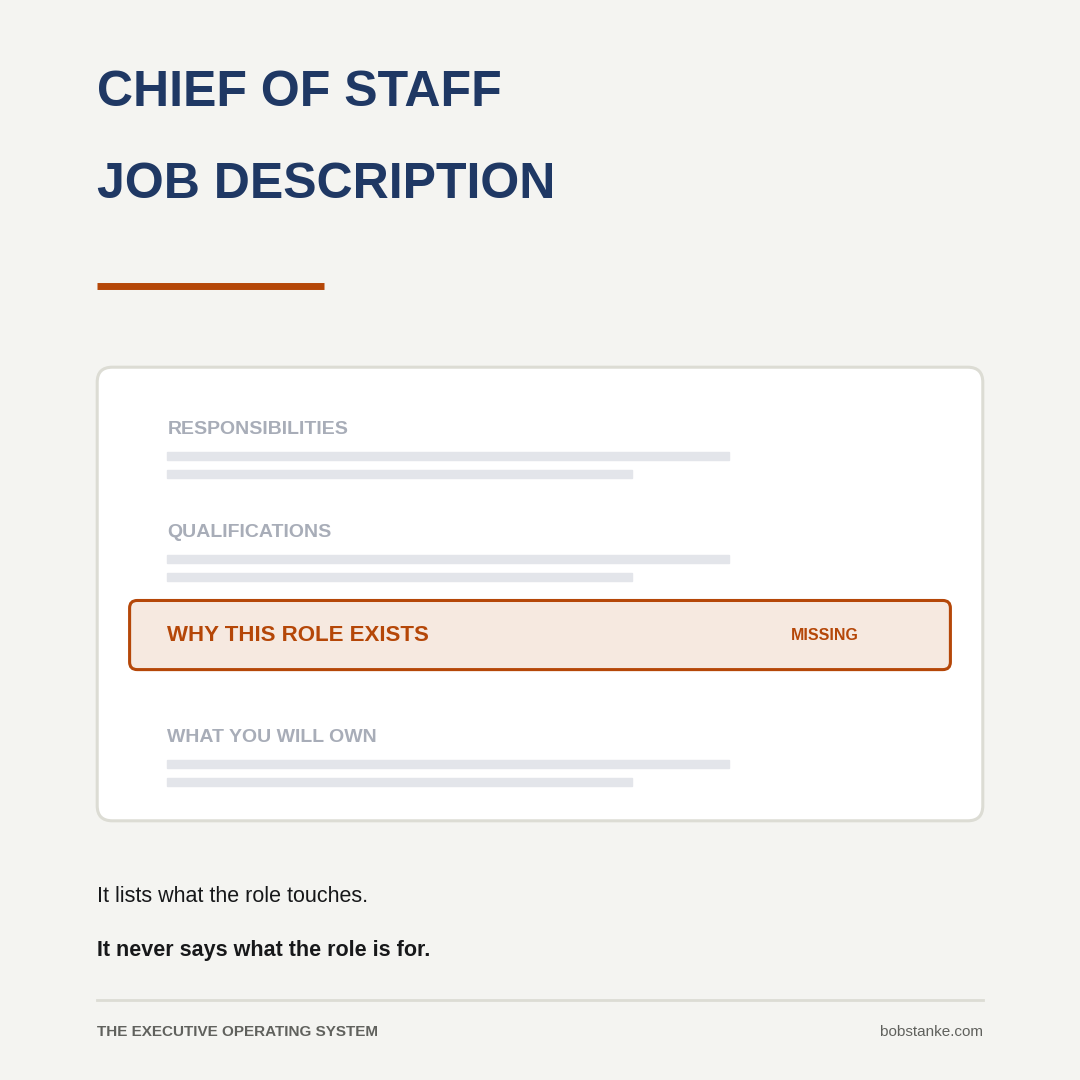
Open any Chief of Staff posting and you will find a list. Strategic projects. Cross-functional initiatives. Meeting facilitation. Executive communications. Special projects as assigned.
Every item is technically accurate, and the list as a whole is close to useless, because it describes what the role touches rather than what the role is for.
Two consequences follow, and both are expensive.
You attract project managers. A list of projects and initiatives reads, to anyone scanning it, as program management with a nicer title. So that is who applies, that is who interviews well against the stated criteria, and that is who you hire. Program management is a real profession that deserves its own name, and it is not this job.
Nobody can tell whether they would be good at it. The strongest candidates for this role are people who have run something adjacent and have judgment. They read a list of activities, cannot find themselves in it, and move on.
The document is where the mis-hire begins, and it is the cheapest place to fix it.
The one section almost every posting is missing
Why this role exists.
Not the responsibilities. The gap.
A Chief of Staff role is shaped by whatever the principal is worst at, or has run out of capacity for. A founder who is brilliant at product and avoids conflict needs a very different person than an operator who decides fast and communicates badly. Same title, barely the same job.
If you cannot write two honest sentences about what specifically has outgrown you, you are not ready to write the posting, and arguably not ready to hire. That paragraph is also the single best filter you have, because the right candidate reads it and recognizes the problem.
What to say instead
| Most job descriptions say | Say this instead |
|---|---|
| Manage strategic projects and initiatives | Decide what reaches me and what does not |
| Facilitate leadership meetings | Own the operating cadence and kill the meetings that produce no decisions |
| Support executive communications | Make sure decisions that need me arrive framed, with a recommendation |
| Drive cross-functional alignment | Find the work sitting on my desk that belonged three levels down two years ago |
| Other duties as assigned | Delete it. It is where scope creep gets written into the contract. |
Scroll the table sideways to see both columns.
The right column is harder to write because it requires you to have thought about the problem. That difficulty is the point, and it is also the filter that attracts the right candidate.
The right-hand column is harder to write because it requires you to have thought about the problem. That difficulty is the point.
The Chief of Staff Job Description Template [Free Download]
Not only are the majority of Chief of Staff job descriptions that get posted on LinkedIn and job boards incorrect, they are incredibly dry.
The Chief of Staff role is so unique, and in many ways personal, so I wanted to give a fresh take on how I think the job description should be written. Below is a link to download my free Chief of Staff Job Description template.
You will notice that is is written like it is coming from the keyboard of the executive principal the CoS will work directly with, which is a much different approach to a job description right off the bat.
Download the template, fill in all the information in brackets, remove the footer, and you are ready to find your next Chief of Staff!
Another option, would be to work with me directly, as I offer Fractional Chief of Staff services. Reach out and let’s talk!
Five lines to cut from whatever you have now
"Other duties as assigned." In most roles this is harmless boilerplate. In this one it is the scope creep that makes the job unbounded and gets your hire to eighteen months and burned out. The role is broad enough already.
"Serve as a trusted advisor and thought partner." True and unfalsifiable. It describes a relationship you cannot assign in a document. It will be true or it will not, and writing it down does nothing either way.
Anything with the word "seamless." Along with "drive alignment" and "ensure synergy." These are what a posting says when nobody has decided what the job is.
A years-of-experience minimum. This role is the clearest case in the company where judgment and experience come apart. Some of the best Chief of Staff hires are three years out of a very good school of hard knocks. Some of the worst have fifteen years of project management.
Any implication that this is a stepping stone to running the company. It might become one. Writing it down attracts people who want the next job rather than this one, and a Chief of Staff who is auditioning for command starts issuing instructions, at which point the borrowed authority the job runs on quietly disappears.
Before you post it
Three checks, and the first one is the one people skip.
Read your "why this role exists" paragraph to someone on your leadership team. If they cannot immediately name the problem you are describing, the gap is not as obvious from outside as it feels from inside, and the posting will not filter correctly.
Check whether you have actually described one job. If the four ownership bullets pull toward one function, you do not have a Chief of Staff problem. You have a missing functional leader, and a generalist is an expensive way to postpone that hire. When to hire a Chief of Staff covers the signals that mean yes, and the five reasons people hire one and regret it.
Decide the authority line before you post, not after. The brackets in the authority section are the hardest part of the template and the most important. If you cannot fill them in specifically, the person you hire will spend their first six months discovering the limits by hitting them, in public, which is the fastest way to burn the role's credibility.
If you are not sure you need a full-time one
Worth naming, because a large share of the people who write this document should not post it.
The role is expensive, the search runs three to six months, and it is genuinely hard to justify below a certain scale. What a fractional Chief of Staff costs covers the numbers on both, including the honest comparison against a full-time hire.
There is also a diagnostic step most people skip. The four things in the ownership section above map to the four components of the Executive Operating System: what reaches you, where your attention goes, what waits on your decision, what leaves your desk. Executives are usually wrong about which of the four is actually binding, and hiring against the wrong one is a costly way to find out.
The Executive Operating Index scores all four in about six minutes and names the binding one. It is free, and worth doing before you spend six figures on a seat.
And if the role you are describing turns out to have direct reports and a function to own, you are writing a different posting. Chief of Staff vs COO vs Executive Assistant covers which of the three you actually need.
