How Many Meetings Should an Executive Have?
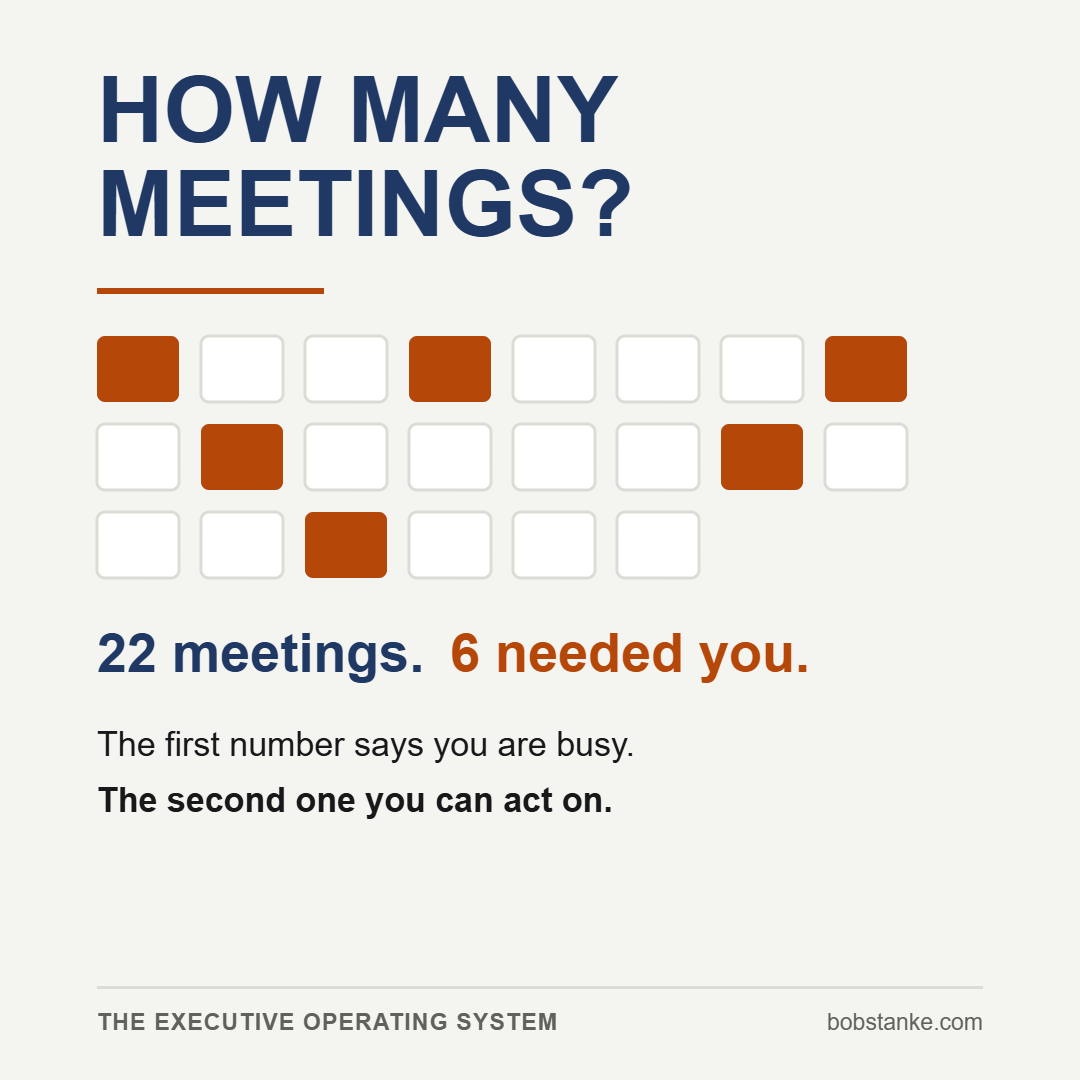
You want a number. Here is the one you will find, and then here is why it cannot help you.
In 2018, Michael Porter and Nitin Nohria published the most careful study of executive time that exists. They tracked 27 Fortune 500 CEOs for thirteen straight weeks, logging every hour. Those CEOs worked an average of 62.5 hours a week and spent roughly 72% of that working time in meetings.
It is a genuinely good study. It also cannot answer your question, and the reason is in the sample.
Twenty-seven people, all running very large companies, all doing a job whose core function is being in rooms with other people. If you run a 90-person company, or a function inside a larger one, you are not doing that job. The number describes what is typical for a group you are not in, and typical was never the same thing as right.
So the honest answer to "how many meetings should I have" is that nobody can tell you, and anyone who gives you a figure is selling something.
Which would be an unsatisfying place to stop. So here is the question that does have a usable answer.
Not how many. How many need you.
Take last week and sort every meeting into three piles.
| Bucket | What it means | The test |
|---|---|---|
| You decide | A decision got made and you were the one who could make it | Something was true after that was not true before, and only you could have made it so |
| You inform | You carried information nobody else had | Could you have written it down instead? If yes, it belongs in the third bucket |
| You attend | You were there because you were invited | Across the last three occurrences, did you change what happened next? |
Scroll the table sideways to see every column.
Run honestly for the first time, most executives find the third bucket is the largest, and not by a little. That bucket is where nearly all the recoverable time sits.
Most executives, running this honestly for the first time, find the third bucket is the largest. Not by a little.
That is the number worth knowing. Not twenty-two meetings. Twenty-two meetings, six of which needed you.
The first number tells you that you are busy, which you already knew and cannot act on. The second tells you exactly where the recoverable time is, and the recoverable time is nearly all in one pile.
Sorting the "you attend" bucket is covered properly in the four meetings every executive should cancel, because each archetype in it has a different cause and a different script.
The second ratio, which almost nobody checks
Here is the part that surprised me, and it is the reason I stopped treating meeting count as the headline number.
Total meeting hours predicts less about whether a week worked than whether any unbroken block survived it.
Four hours of meetings in one morning leaves you an afternoon. Four hours scattered across a day in forty-minute pieces leaves you nothing, because the gaps between them are too short to start anything that requires holding a problem in your head.
Same total. Completely different week.
That is why "reduce your meetings by 20%" so often produces no felt improvement. If the reduction comes evenly off the top, the fragmentation is untouched and the week feels identical. The thing that changes how a week feels is not the total, it is whether the remaining meetings are clustered or sprayed.
Two hours to think covers what to do with a block once you have defended one, and why it is the first thing sacrificed when the calendar gets tight.
What I have seen so far, and what I have not
I run a free assessment that records meeting hours, uninterrupted blocks, and the share of time an executive believes goes to their stated priorities. Enough people have taken it now that a pattern is visible.
The people reporting the most trouble are not consistently the most heavily booked ones. They are the ones with no contiguous block, at almost any total.
I want to be precise about the status of that. The sample is currently small enough that I would not publish a median from it, and I am not going to, because a number from a handful of people gets quoted without its caveat the moment anyone lifts it. What I have is an observation, not a finding. It is consistent with the mechanism above, which is why I am willing to say it out loud, and it is not evidence.
When the sample is large enough to support real figures, I will publish those instead, caveats and all.
What to actually do
Sort one week into the three buckets. Not a typical week, last week, because typical weeks are reconstructed and reconstruction flatters. This is the same exercise as auditing your calendar, applied to a narrower question.
Attack the third bucket only. The first two are the job. Trying to reduce your total is how people end up cutting the wrong meetings and concluding the exercise does not work.
Then check the fragmentation separately. Look at the remaining week and find the longest uninterrupted stretch. If it is under ninety minutes, your problem is arrangement rather than volume, and the fix is consolidating meetings into blocks rather than removing more of them.
Re-measure the ratio in a month, not the total. The total will drift back. The ratio is the thing you are actually managing, and it is the one that tells you whether anything changed.
Where this sits in the operating system
Meetings are the visible surface of Attention, the second of four components in the Executive Operating System: what reaches you, where your attention goes, what waits on your decision, what leaves your desk.
Worth saying plainly though, because it explains why calendar work so often disappoints. A meeting problem is usually an intake problem or a decision problem that has surfaced on your calendar. Meetings you attend without affecting are frequently there because nobody decided what should reach you. Meetings that recur without resolving are there because a decision has no owner. Attention is where the symptoms land. It is rarely where the cause lives.
Add your number
The Executive Operating Index takes about six minutes. It scores all four components, names the one actually binding for you, and records your meeting hours and longest uninterrupted block along the way.
It is free, your score appears before you are asked for anything, and every response makes the data behind posts like this one better. If you want to know whether your problem is volume or arrangement, that is the fastest way to find out.
Take the Executive Operating Index
FAQ
How many meetings should an executive have?
There is no correct number, and any figure you find describes a group you are probably not in. The most careful study tracked 27 Fortune 500 CEOs, who spent about 72% of their working time in meetings. A more useful question is how many of your meetings actually need you.
How much time do executives spend in meetings?
Porter and Nohria tracked 27 Fortune 500 CEOs over thirteen weeks and found average weeks of 62.5 hours with roughly 72% of that time in meetings. That sample is large-company chief executives, whose job is structurally meeting-heavy, so it transfers poorly to other executive roles.
How do I know if I have too many meetings?
Sort last week into three buckets: meetings where you decided something, meetings where you carried information only you had, and meetings you attended because you were invited. The third bucket is your recoverable time. Most executives find it is the largest one.
Is it better to have fewer meetings or fewer interruptions?
Usually fewer interruptions. Four hours of meetings in one morning leaves you an afternoon. The same four hours scattered in forty-minute pieces leaves you nothing, because the gaps are too short to hold a problem in your head. Consolidate before you cut.
