Your Team Is Not Avoiding Ownership. They Do Not Have It.
You have said some version of this out loud, probably recently.
They do not take ownership. I have to chase everything. Nobody around here thinks like an owner.
It is one of the most common complaints in management, and it is almost always aimed at the wrong thing. Ownership is not a mindset, a value, or a personality trait you hire for. It is a set of permissions, and most people described as failing to take ownership were never given them.
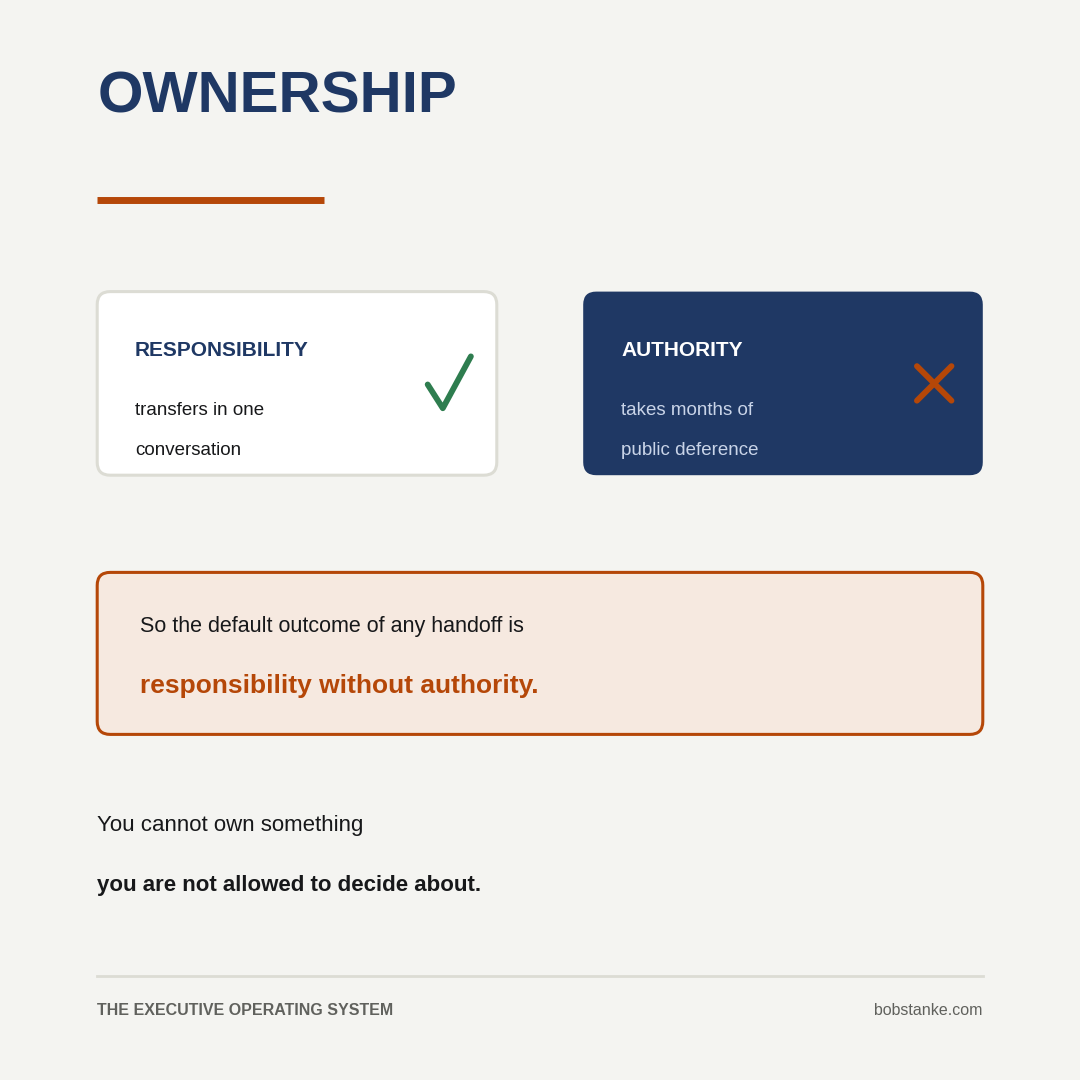
You cannot own something you are not allowed to decide about.
What you actually handed over
Think about the conversation where you gave someone the thing. You told them it was theirs. You probably meant it.
Here is what transferred in that conversation: responsibility. The expectation that if it goes badly, it lands on them.
Here is what did not transfer: authority. The ability to spend, decide, commit, and be wrong without checking first.
Responsibility moves in a single conversation. Authority moves only through months of repeated public deference.
That asymmetry is the whole thing. One half of the handoff is free and instant, and it feels like the whole job is done. The other half is ongoing, slightly uncomfortable every single time, and invisible when it works. So the default outcome of any delegation, without deliberate effort, is responsibility without authority.
Nobody chooses that. It is just what happens when one half of a transfer completes by itself and the other never does.
What it looks like from their side
This is the part worth sitting with, because it explains behavior that otherwise looks like disengagement.
They were told they own it. Then their first decision got reviewed. Their second got revised. Their third got reversed in a meeting, politely, in front of two other people.
By the fourth, they have learned the actual rule, and it is not the stated one. The real rule is decisions here get checked. So they start checking. Not out of laziness. Out of accurate pattern recognition, because checking is now clearly cheaper than deciding and being overturned.
From where you sit, that reads as a lack of ownership.
From where they sit, it reads as having correctly identified how this place works.
A person who checks with you before deciding has usually been trained to, and you were probably the trainer. Not deliberately, and not unreasonably. Every individual correction you made was defensible. The aggregate taught a lesson you did not intend.
Four tests for what you actually gave
Ownership is not a feeling, so stop assessing it by whether someone seems invested. Assess it by what they are permitted to do.
| Test | The question | If the answer is no |
|---|---|---|
| Spend | Can they commit money here without asking you? | They own the work, not the outcome |
| Decide | Can they make the call without checking first? | You own it, they administer it |
| Be wrong | Can they make a mistake without it being escalated? | They will optimize for not being blamed |
| Know first | Do they hear about problems here before you do? | The organization was never told they own it |
Scroll the table sideways to see every column.
The last test catches what the others miss. You can grant every permission privately and still keep ownership, because the rest of the company keeps routing around the person to you.
That last one catches something the others miss. You can grant every permission in private and still keep ownership, because the rest of the company keeps routing around the person to you. If people bring you problems in their area, the org has not been told, or has been told and does not believe it.
A rough measure, and treat it as a rule of thumb rather than research: count how many of their decisions you touched last month. Reviewed, revised, reversed, or were asked about in advance. If it is more than about one in ten, they do not own it, whatever the org chart says.
What actually transfers authority
None of this is a conversation. It is a series of small, visible, slightly uncomfortable choices.
Route questions to them in front of other people. When someone brings the question to you, do not answer it and mention them. Say "that is Priya's call" and stop talking. The audience matters more than the answer.
Let a decision you would have made differently stand. This is the entire transfer, compressed into one moment, and it is the one most managers cannot do. If you only defer when you agree, you have not delegated anything. You have installed a slower version of yourself.
Announce the scope rather than just granting it. Tell the team, in a room, what this person now decides without you. Unannounced authority is not authority, because everyone else is still working off the old map.
Get yourself off the copy line. As long as you see everything, you will react to something, and one reaction restarts the whole pattern. This is the same ratchet that governs your calendar, and the fix is the same: change what reaches you rather than trying to be more restrained about it.
Fix mistakes afterward, in private, as a rule change. The correction is not the problem. Correcting in public, in the moment, is, because it is a live demonstration that the decision was never really theirs.
Sometimes it really is the person
Worth saying plainly, because the argument above can be taken too far.
Occasionally you grant every permission, announce it, defer publicly, absorb a couple of bad calls, and the person still will not move without you. That happens. Some people genuinely do not want the exposure that comes with deciding, and a few are in a role they are not ready for.
The test is whether you have actually run the experiment. If you cannot point to a specific decision you disagreed with and let stand anyway, you have not. Until then, the ownership question is unanswered, and the person is not the variable you have been changing.
Where this sits in the operating system
Distribution is the fourth component of the Executive Operating System: what reaches you, where your attention goes, what waits on your decision, what leaves your desk.
It is last for a reason. Work only truly leaves when the authority to run it leaves with it. Otherwise you have moved the labor and kept the decisions, which produces the worst version of both: they do the work, you carry the load, and everyone is frustrated with the other one.
The direct fix is upstream in Decisions. Mapping your decision rights covers how to write down what someone can decide without you, in dollar amounts and thresholds rather than in adjectives, and it is the single highest-yield thing on this list.
Two more worth reading. Delegating so work does not come back covers the mechanics of the handoff itself. And managing managers covers what happens to your information when the people between you and the work have their own interests in how it looks.
If you want to know whether Distribution is genuinely your binding constraint, the Executive Operating Index scores all four components in about six minutes.
FAQ
Why won't my team take ownership?
Usually because they have responsibility without authority. Responsibility transfers in one conversation. Authority transfers only through months of visible deference, so it often never does. Someone who checks before deciding has typically learned that decisions here get reviewed, which is accurate pattern recognition rather than disengagement.
How do I get my team to take more ownership?
Grant permissions rather than encouragement. Let them spend within a limit, decide without checking, and be wrong without escalation. Then announce the scope publicly, route questions to them in front of others, and let at least one decision you disagree with stand. That last one is the actual transfer.
How do I know if someone really owns their area?
Four tests. Can they commit money without asking, decide without checking, be wrong without it escalating, and do they hear about problems before you do? Also count how many of their decisions you touched last month. More than roughly one in ten means they do not own it.
What if I give them authority and they make a bad call?
Expect it, and absorb the first few. Correct afterward, in private, as a change to the rule rather than a reversal of the decision. Correcting publicly in the moment demonstrates to everyone watching that the decision was never actually theirs, which restarts the pattern.
