Director to VP
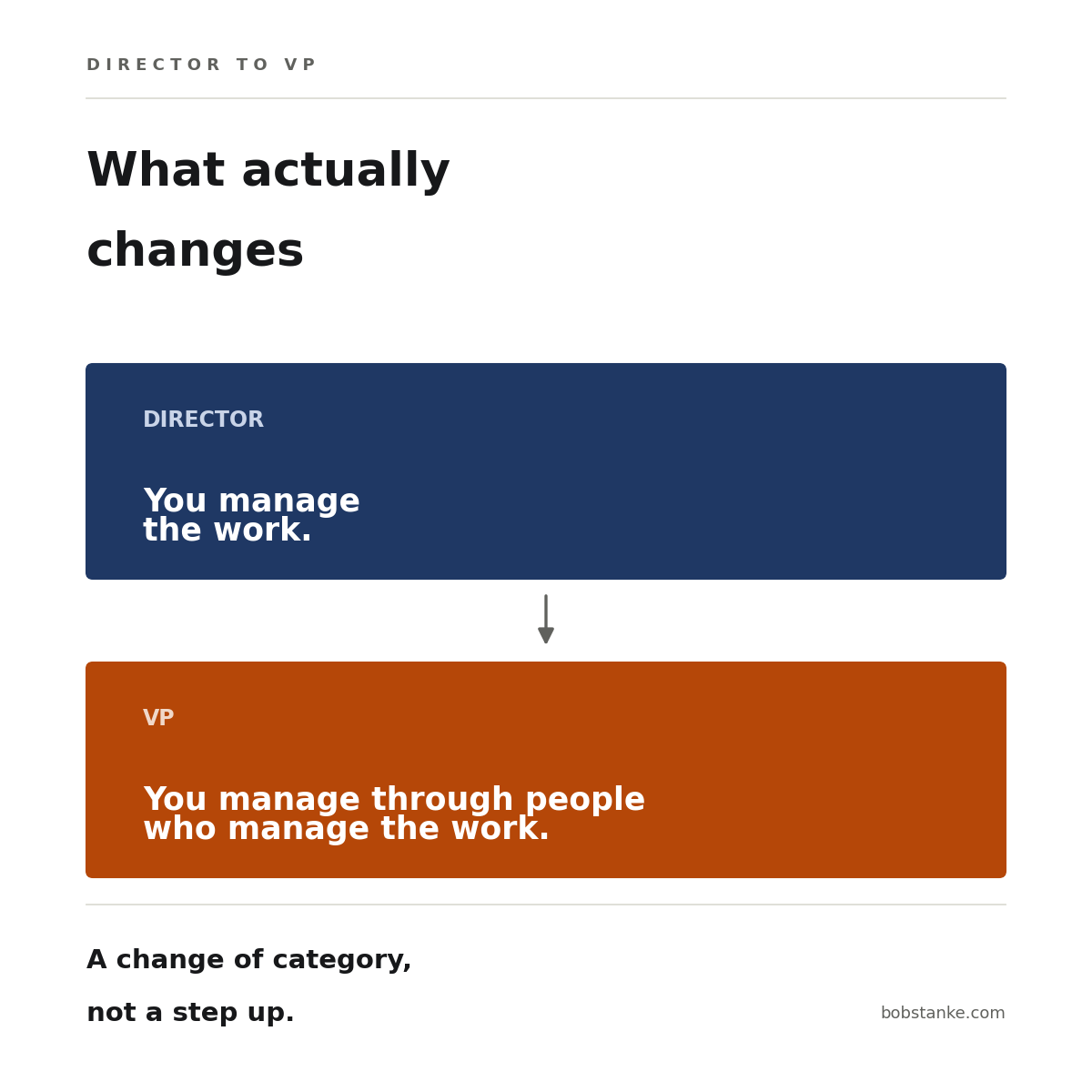
The Director job is to manage work. The VP job is to manage through people who manage work.
That is not a difference of degree. It is a change of category, and almost everything difficult about the transition follows from it.
Most advice on this jump is about behavior: think more strategically, build relationships across the business, develop executive presence. All true, all downstream. What follows is the mechanical version, which is more useful because you can act on it.
NOTE: If you are a step earlier than this, the manager to director jump is a different problem.
The five things that change
1. Your information about reality becomes secondhand
As a Director you saw the work. You were close enough to notice when something was drifting before anyone reported it.
As a VP you see reports about the work, filtered through people who have a legitimate interest in how those reports read. That is not dishonesty. Every layer smooths, because every layer is staffed by people who prefer to solve a problem before mentioning it.
The practical consequence is that your picture of reality is now systematically about two weeks old and slightly better than the truth. The instinct to fix this by getting closer to the work is the single most common failure of new VPs, and it makes things worse, because it teaches the layer beneath you that their judgment will be overridden.
2. Your span roughly triples and your context thins
More surface area, less depth on any part of it.
You will no longer be the most knowledgeable person about anything in your organization, and that is correct rather than a gap to close. Directors are usually promoted for being excellent at the thing. VPs have to become comfortable with being unable to personally verify most of what they are accountable for.
3. Your calendar stops being yours
As a Director, most of your meetings were with your team, about work, and you controlled roughly half of them.
As a VP, most of them are with peers and above, about coordination, and you control almost none. Your week is now authored by other people's planning cycles, other functions' escalations, and a leadership rhythm you inherited rather than designed.
Nobody mentions this because it looks like a schedule problem. It is not. It is the point at which your calendar becomes an inherited system rather than a personal one.
4. You become a decision destination
At Director level you made decisions about work you understood directly.
At VP level, decisions arrive about work you cannot see, from people who could reasonably have made the call themselves but escalate because you are now the one with the authority. Ambiguity has a direction, and it now points at you.
Most new VPs do not notice this accumulating, because each individual escalation is reasonable. The volume is what changes, not the character of any single item.
5. Your peers become competitors for resources
This is the least discussed change and it surprises people the most.
As a Director your peers were collaborators. You were mostly optimizing the same thing together, and helping each other cost nothing.
As a VP your peers are also asking for headcount, budget, and priority from the same finite pool. The relationships are still collegial and the incentives are now partly opposed. Nobody explains this on your first day, and it takes most people two quarters to notice why certain conversations feel different.
And one thing that does not change
Your support. You inherit two or three times the scope and, in most companies, exactly the same amount of help you had as a Director, which is usually none.
That gap between responsibility and support is the structural reason this transition is hard. It is not a skill deficit. It is a system that scaled while the resources around it did not.
Why the thing that got you promoted is now the problem
You were made a VP because you were exceptional at the Director job. And the Director job rewards a specific capability: being personally involved enough to guarantee the outcome.
That capability does not scale, and at the new level the instinct behind it becomes the constraint.
The pattern is consistent. Someone who was promoted for absorbing enormous volume through personal effort tries the same approach at triple the scope, works longer, and concludes around month three that they were not ready. They were ready. They were applying a method that has a hard ceiling, and they have just met it.
Nothing about this is a readiness problem. It is a design problem, and it is the reason the transition feels like a character test when it is actually a structural one.
What to do, in order
Four moves, one per layer of how you now operate. The order matters, because each makes the next possible.
1. Fix what reaches you first
Being promoted puts you on distribution lists you did not ask for, in escalation paths nobody told you about, and in the mental model of several hundred people as someone who can now unblock things.
Count the separate ways people can reach you with something requiring action. Email, each chat tool, project tool messages, text, phone, calendar invites, ticketing, document comments, people stopping you. Most senior leaders find nine to twelve and would have guessed four.
Then stop one recurring report without announcing it and see whether anyone asks. The mechanics are here.
Do this before you touch your calendar. Clearing time without changing inflow gets you about three weeks, which is precisely why so many new VPs conclude that time management does not work for them.
2. Write down what does not need you
Your team is currently over-escalating on purpose. They do not yet know your thresholds, and guessing wrong upward is safer for them than guessing wrong downward.
Four or five lines is enough. Something reaches you if it crosses a spending number you name, affects a named customer or partner, sets a precedent, cannot be reversed, or crosses into another function. Everything else gets decided below you and reported afterward.
Written criteria are the only version of this that scales, because they let people filter themselves rather than guessing at your preferences.
3. Delegate outcomes, not tasks
At Director level you could delegate a task and stay close enough to catch the edge cases yourself. At VP level you cannot, because you will not see them.
Tasks come back. Instructions never cover the case that actually arises, and when the person hits the gap the only move available is to return to you. Outcomes with real authority do not come back the same way, because the person can handle the unexpected case.
The trade is that they will handle it differently from how you would have. That is not a side effect of delegation. That is what delegation is.
4. Then, and only then, rebuild the week
Now the calendar work will hold, because the inflow that used to refill it has rules and the decisions that used to queue have owners.
Protect two blocks of two hours or more. Not five. Two, defended properly, because a week with a shape can be violated and you will notice.
What to stop doing
Three habits that served you well as a Director and now actively cost you.
Being the quality backstop. You cannot personally verify most of what you are accountable for, and attempting it teaches your managers that their judgment is provisional. The cost of that lesson compounds quietly for years.
Answering quickly. Responsiveness was a virtue at the previous level and is now a signal that everything can be escalated to you cheaply. A reply within four minutes is a promise about future availability that you cannot keep at this scope.
Reaching into the work when something feels wrong. The instinct is sound and the action is usually wrong. Ask the person who owns it what they are seeing. If the answer is not good enough, that is a capability problem you now have to solve properly rather than route around.
How to tell whether it is working
Three numbers, at ninety days and again at six months.
Meeting hours per week. If it has climbed every month since you started and never fallen, your calendar is being authored entirely by other people.
Uninterrupted blocks of two hours or more. Count them in a normal week. Zero or one means you have no capacity for the work you were actually promoted to do, no matter how full the week appears.
Percentage of your time on your stated top three priorities. Write the three from memory, then check against sixty days of calendar. Most people estimate thirty or forty percent. The real figure is usually much lower, and the gap is the clearest available evidence that this is a design problem rather than an effort problem.
If you want those scored properly, the Executive Operating Index does it in about five minutes and names which of the four is actually holding you back. It is free, and your score appears before you are asked for anything.
The honest summary
The Director to VP jump is the point at which personal capability stops being the main input to your results, and system design starts.
That is a genuinely disorienting change, because personal capability is the thing you have been rewarded for at every previous level, and nobody tells you the returns on it have stopped compounding.
The people who settle into the VP role are not the ones who worked hardest in the first year. They are the ones who spent the first six months redesigning what they inherited instead of absorbing it.
FAQ
What is the difference between a Director and a VP? A Director manages work, usually with direct visibility into it. A VP manages through people who manage work, with visibility that is secondhand and slightly delayed. It is a change of category rather than a step up in scope.
Why is the Director to VP transition so hard? Because the trait that earns the promotion, being personally involved enough to guarantee outcomes, does not scale to the new level. Scope roughly triples while support usually stays the same, and most people respond by working harder inside a system they inherited.
How long does it take to feel settled as a new VP? Six to twelve months is normal. The difficulty typically arrives around day sixty rather than day one, because volume takes weeks to catch up with the title.
What should a new VP do first? Audit what you inherited before changing anything, then fix what reaches you before you touch your calendar. Reversing that order produces improvements that revert within a month.
Do VPs still do hands on work? Some, and less than they expect. The common mistake is treating hands on work as a way to stay close to reality. It is more reliable to fix the reporting so that reality reaches you accurately.
What is the most common mistake new VPs make? Trying to close the information gap by getting closer to the work. It feels responsible, it teaches the layer below that their judgment is provisional, and it consumes the capacity the role actually requires.
Bob Stanke is a Chief of Staff and Executive Advisor. He writes about the operating layer of executive work: what reaches you, where your attention goes, how decisions clear, and what leaves your desk.
