How to Audit Your Calendar

A calendar audit is a structured review of your past calendar data that measures where your time actually went, rather than where you believe it went. It takes about thirty minutes, requires nothing but an export and a spreadsheet, and it is the fastest way to find out whether the way you're working matches the job you think you're doing.
Most executives have never done one. Here's the procedure.
What you need before you start
Sixty days of calendar history. Both Google Calendar and Outlook will export to CSV in a couple of clicks. Sixty days matters. A single week is too easy to dismiss as unusual, and every week feels unusual from the inside.
A spreadsheet with five columns: event title, duration in minutes, category, decision-maker (yes/no), and priority-linked (yes/no).
One rule before you begin: do not clean anything up first. The instinct is to wait for a normal stretch, or to mentally set aside the quarter-end crunch and the two weeks of travel. Resist it. There is no normal period. The exceptions are the job, and an audit that excludes them measures a calendar you don't actually have.
Step 1: Classify every block
Sort each event into one of four buckets:
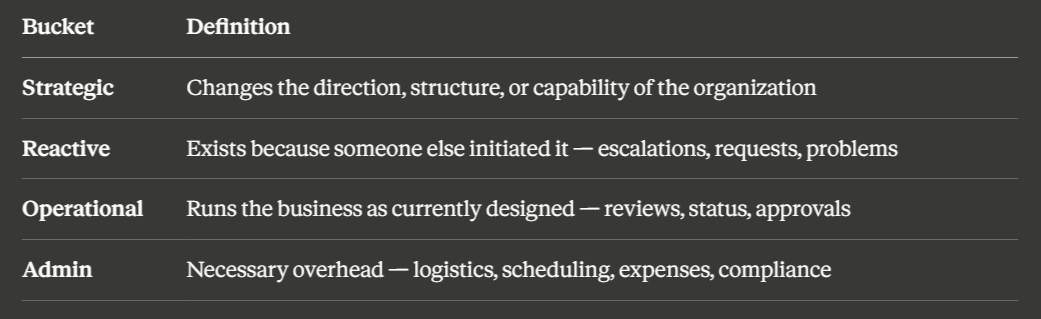
The governing rule: classify by what the block produced, not what it was called. Meeting titles are the least reliable data in the export. "Weekly Sync" is sometimes the most strategic hour of the week; "Strategy Offsite" is sometimes eight hours of status updates. Go by outcome.
Some hard cases, since this is where people stall:
A 1:1 with a direct report. Strategic if you were building their capability or working through a genuine problem. Operational if it was status. Most 1:1s are operational and most executives believe they're strategic.
Board or exec team meetings. The preparation is usually strategic. The meeting itself is often operational or admin. Split the block.
Recurring meetings you didn't create. Classify honestly by what happens in them, not by their stated purpose. This is where the most uncomfortable reclassification tends to happen.
Travel time. Count it. It's real time and it's usually admin. Excluding it flatters the result.
Blocks you scheduled and then worked through. If you booked two hours to think and spent it on email, classify it as what you did.
Thirty seconds per event, maximum. First instinct is usually right, and precision beyond this adds nothing.
Step 2: Mark where you were the decision-maker
For every meeting, ask one question: would this meeting have been meaningfully different if I hadn't been there?
Not "was it useful to attend", almost everything is somewhat useful. The test is whether your specific authority, knowledge, or judgment was required. If someone else in the room could have carried it, mark it no.
Total the yes column as a percentage of meeting hours. Under half means you're attending your calendar rather than running it.
Step 3: Measure fragmentation
This one is counterintuitive and it's the number most people get wrong.
Fragmentation is not about how much free time you have. It's about how that time is shaped. Four free hours split across eight thirty-minute gaps is not four hours of capacity, it's eight fragments, none long enough to hold a complex problem. Demanding work has a warm-up cost, and a thirty-minute window is consumed entirely by warm-up.
Two numbers:
Count of uninterrupted blocks of 2+ hours during working hours, per week
Average length of contiguous free time, in minutes
Most senior leaders find they have between zero and one two-hour block per week, and are surprised, because their calendars show meaningful total free time. The total was never the constraint.
Step 4: Test your stated priorities against the record
Write down your top three priorities for the quarter. Do this from memory, before looking at the data. Writing them after you've seen the calendar contaminates the test.
Now go back through the sixty days and mark every block that advanced one of those three things. Total the hours. Express it as a percentage of your working time.
This is the number the whole exercise exists to produce.
One step to take after you sort
Meetings are probably going to be a large part of your calendar, and you will need to trim those down. I wrote an article about which four meetings to cut first, so make sure to check that out. Then the next article you should check out is one I wrote about what is the right number of meetings to be in each week.
What do the numbers mean?
Directional benchmarks for senior leaders. Treat them as orientation, not diagnosis.
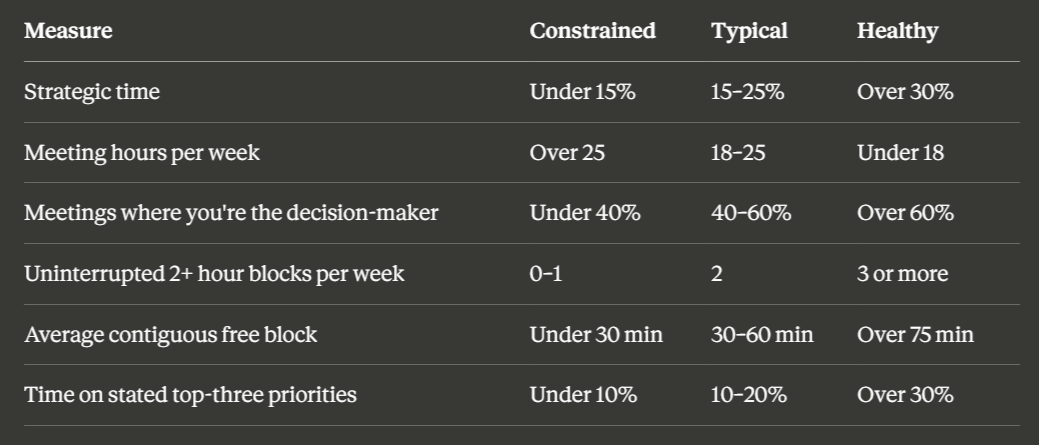
Most people running this for the first time land in "constrained" on at least three rows. That's the normal result, not a personal failing… nobody designed the calendar. It accumulated.
What do you do with the result?
The obvious move is to attack whatever row looks worst. Decline more meetings, block mornings, protect Fridays.
That works for about three weeks.
The calendar is a report, not a cause. It's an unusually honest report and it has no agenda and it can't be argued with. But the reason it looks the way it does is almost always somewhere else. Either too much is reaching you in the first place, or too little is leaving your desk. Clear the calendar without changing either of those and the same forces refill it, usually within a month.
So treat the audit the way you'd treat a P&L. It tells you the system is misaligned and roughly where to look. What it doesn't do is tell you what to change and changing the report rather than the system is how most executives spend a year getting temporarily better at the same problem.
Run it anyway. Thirty minutes for the clearest picture of your own working life you're likely to get this year is an unreasonable return.
FAQ
How long should a calendar audit take? About thirty minutes for sixty days of data, once you have the export. Classification is the bulk of it. Resist spending longer, precision past a first-instinct judgment doesn't change the conclusions.
What if my calendar doesn't reflect my actual work? Then that's the first finding. If significant work happens outside scheduled blocks, your calendar isn't functioning as a plan, it's only capturing your obligations to other people, which is itself a meaningful result.
Should I include time outside working hours? Track it separately. Work that has migrated to evenings and weekends is usually the strategic work that got displaced during the day, and seeing that pattern explicitly is often the most useful output of the whole exercise.
How often should I re-run it? Quarterly is plenty. The value comes from comparing periods, so keep the classification rules consistent. Inconsistent classification makes the comparison meaningless.
Can I automate this? Partially. Rules based on attendee count, recurrence, and organizer will classify perhaps two-thirds of blocks reliably. The remaining third is where the interesting findings hide, and it needs judgment.
Bob Stanke is a Chief of Staff, the role companies create when an executive's operating system has outgrown them. He writes about the operating layer of executive work: what reaches you, where your attention goes, how decisions clear, and what leaves your desk.
