A Decision Rights Template You Can Fill In This Afternoon
You have probably tried this before. Someone suggested writing down who decides what, you spent a morning on it, and the document is now in a folder nobody has opened since.
That is the normal outcome, and it is not a discipline problem. Most of these documents are built wrong in a specific way.
The mistake: writing a permission list
Almost every authority document is a list of things people are allowed to do. Managers may approve expenses under $500. Directors may sign vendor agreements up to twelve months. Regional leads may authorize overtime.
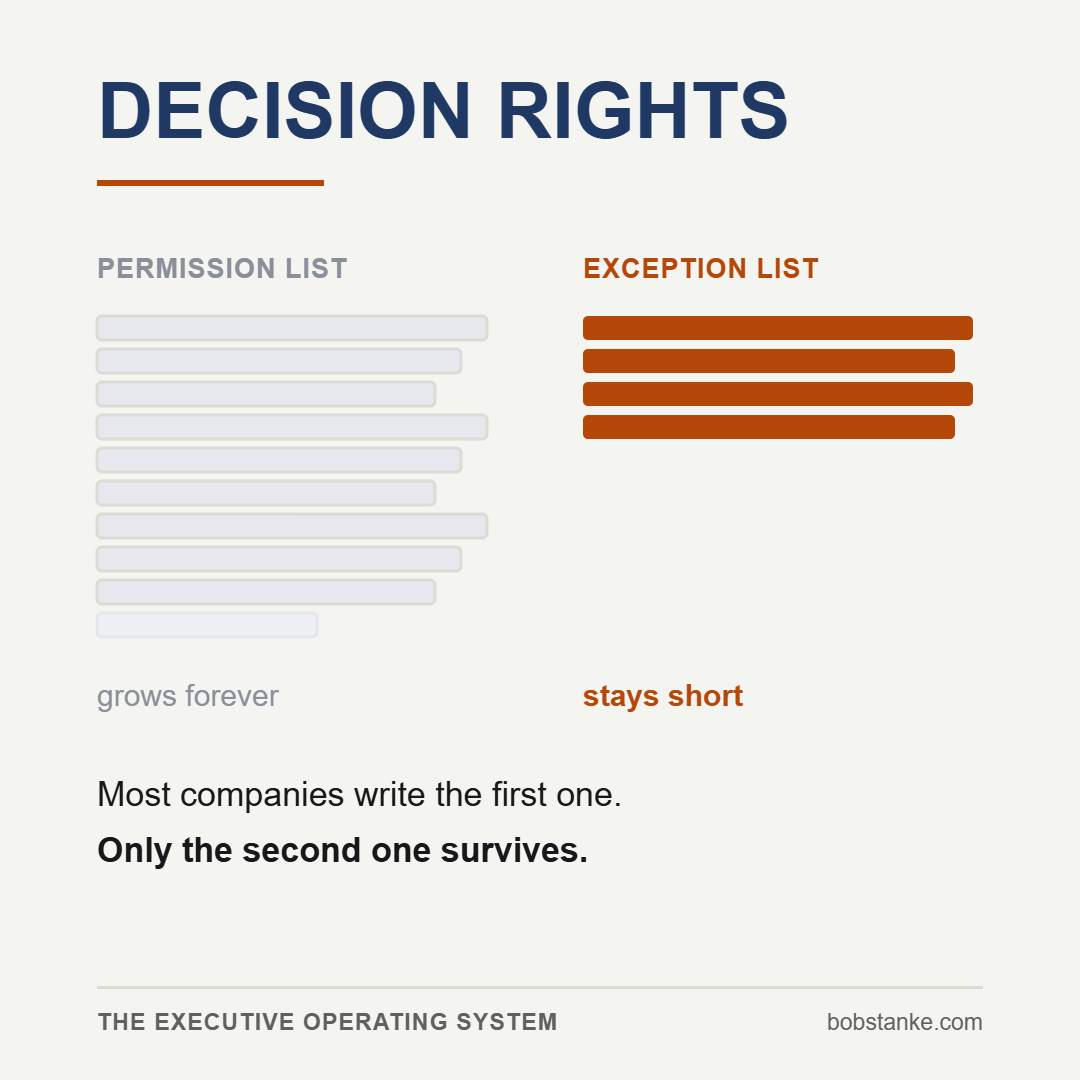
That structure has one fatal property. A permission list grows forever, because every new situation the list does not cover becomes a request for a new permission. Six months in it is eleven pages, nobody has read it, and the practical rule reverts to asking you.
An exception list does the opposite. It says: decide everything in your area, except these four things. Every time an ambiguity gets resolved, it comes off the list rather than going on it. Same document, opposite trajectory.
The whole template below is built on that inversion, and it is the only part that really matters. If you take nothing else, take this:
The default is "decide it and tell me." The document exists only to name the exceptions.
Most companies have that exactly backwards, which is why their authority documents get longer every year and their executives stay just as busy.
The three properties of one that gets used
Numbers, not adjectives. "Significant spend" and "major customer commitment" are not thresholds, they are invitations to check with you. A threshold is a dollar amount, a headcount, a contract length, or a named customer tier. If somebody could reasonably ask "does this count," it is not written tightly enough.
Four rows, not twenty. The reason these documents die is that people try to be comprehensive on the first pass. You cannot enumerate every decision in your organization and you will exhaust yourself trying. Four rows that are actually true beat twenty that are aspirational.
It lives where decisions happen. Not in a policy folder. Pinned in the channel, at the top of the leadership team doc, in the meeting template. A document that requires someone to go looking is a document that will be replaced by asking you, because asking you is faster.
THE DECISION RIGHTS TEMPLATE
Copy this. Fill in four rows. Leave the rest for later.
The default
If a decision is in your area and is not listed below, make it. Tell me afterward if it is material. Do not wait for me.
If you are unsure whether something is listed, it is not. Decide it.
The exceptions · these four come to me first
| Decision | Comes to me when | Who decides otherwise |
|---|---|---|
| [Spend] | [Over $X] | [Name] |
| [Hiring] | [Any net-new head] | [Name] |
| [Pricing / discounts] | [Over X% off list] | [Name] |
| [Customer promises] | [Anything in a signed contract] | [Name] |
Scroll the table sideways to see every column.
Reversibility override
If a decision on this list can be undone within a week at low cost, make it anyway and tell me. The list is for one-way doors.
When I get it wrong
If I overrule something that was yours to decide, that is a mistake on my part and I want to hear about it. We will change the line rather than work around it.
A worked example
Empty templates are hard to reason about, so here is one filled in for a VP of Operations at a roughly 120-person company.
| Decision | Comes to me when | Who decides otherwise |
|---|---|---|
| Spend | Over $15,000, or any recurring cost over $2,000 a month | Dana |
| Hiring | Any net-new headcount. Backfills are yours. | Dana |
| Vendor contracts | Term over 12 months, or auto-renew with over 60 days notice | Dana |
| Customer commitments | Anything that ends up in a signed contract or an SLA | Dana |
Scroll the table sideways to see every column.
Four rows. Nothing about meetings, travel, tooling, process changes or team structure below her direct reports, because all of those now fall under the default, which is decide it. A number cannot be negotiated at the moment of decision, and that is the entire point.
Four rows. Nothing about meetings, travel, tooling, process changes, team structure below her direct reports, or the hundred other things that used to generate a check-in. All of those now fall under the default, which is decide it.
Notice how specific the thresholds are. Not "large purchases." Fifteen thousand dollars. Not "long contracts." Twelve months. A number cannot be negotiated at the moment of decision, which is the entire point, because the moment of decision is when both of you are busy and the path of least resistance is to ask.
How to fill it in
Start with the row you are least comfortable writing. That is almost always spend or hiring, and it is the one carrying the most traffic. If you write the three easy rows and stall on the hard one, you have built a document that changes nothing.
Set each threshold at the number that makes you slightly uncomfortable. If a figure feels obviously safe, it is too low and you have not actually delegated anything. The right number is the one where you think "I would probably want to know about that" and grant it anyway. You will be wrong occasionally. Being wrong occasionally is what the delegation costs, and it is cheaper than the alternative.
Name a person in every row, not a team. "The leadership team decides" means nobody decides. If two people have to agree, name the tiebreaker.
Put a review date ninety days out and honor it. Not to add rows. To remove them, because after a quarter you will know which exceptions never came up.
The rule that decides whether it survives
A line you override twice is not a line.
The first override is usually right. Something genuinely unusual arrives and the threshold was not built for it.
The second is where the document dies, because everyone watching has now learned the actual rule: the written line holds unless the situation feels important enough, and importance is judged by you. Which is exactly the state you were in before you wrote anything down.
If you find yourself heading for a third override, the threshold is wrong. Change the number out loud, in the document, with a date. That costs you two minutes and preserves the thing. Overriding quietly costs you nothing today and the whole document within a quarter.
This is the same failure that kills rules elsewhere in an operating system, and I have written about it in the context of saying no, where the mechanism is identical.
What this actually fixes
Three things, and they are the symptoms most executives try to treat directly.
Decisions stop sitting. The most common reason a decision waits eleven days is not that it is hard. It is that nobody was sure it was theirs, and checking is free while being wrong is not.
Your decision volume drops. Not your decision quality, your count. The count is what produces the afternoon slump, which I have covered in decision fatigue.
People start owning things. Ownership is not a mindset, it is a set of permissions, and this document is the permissions written down. Why your team won't take ownership covers why responsibility transfers in a conversation while authority almost never does.
The reasoning underneath all of this, including why unclear authority escalates upward by default, is in mapping your decision rights. This post is that argument turned into something you can paste into a document today.
If you want to know whether Decisions is actually the component holding you back, rather than the loudest one, the Executive Operating Index scores all four in about six minutes.
FAQ
What is a decision rights template?
A short document naming which decisions must come to you and who decides everything else. The working version is an exception list rather than a permission list, so the default is that your team decides and the document only names the few things that require you.
How do I write a decision rights document?
Start with four rows, not twenty. Use numbers rather than adjectives, since "significant spend" is an invitation to check with you and fifteen thousand dollars is not. Name a person in every row rather than a team. Set a ninety day review to remove rows, not add them.
What is the difference between a permission list and an exception list?
A permission list states what people may do, so it grows forever as new situations appear. An exception list states the few things requiring you and shrinks as ambiguities get resolved. Same document, opposite trajectory, and the second one is the one that survives.
What should the spending threshold be?
Whatever number makes you slightly uncomfortable. If a figure feels obviously safe you have not delegated anything. Pick the amount where you think you would probably want to know, and grant it anyway. Being occasionally surprised is what the delegation costs, and it is cheaper than the alternative.
