Decision Fatigue Is Not a Stamina Problem
By four in the afternoon you are making worse decisions than you were at nine in the morning, and you know it. The obvious conclusion is that you ran out of something.
That conclusion is why most of the advice on this is useless.
What the usual advice actually assumes
Wear the same thing every day. Decide important things in the morning. Eat lunch. Batch your approvals. Preserve your willpower for what matters.
Every one of those treats the number of decisions reaching you as a fixed quantity, and then tries to make you better at absorbing it. None of them ask why the number is what it is.
Worth knowing too: the science underneath the stamina model is shakier than its popularity suggests. Ego depletion, the idea that self-control draws down a limited resource, has not replicated reliably in large scale studies. That does not mean you are imagining the afternoon slump. It means the explanation you have been handed for it may not be the right one.
The alternative explanation is duller and more useful. You are not depleted. You are processing a volume that nobody designed.
The count, not the weight
Here is the thing that gives it away.
Think about the hardest decision you made this quarter. A real one, with consequences, where you had to sit with it. Did that decision exhaust you?
Usually not. Hard decisions that matter tend to be the opposite. They are absorbing. You come out of them tired in the way a good workout is tiring.
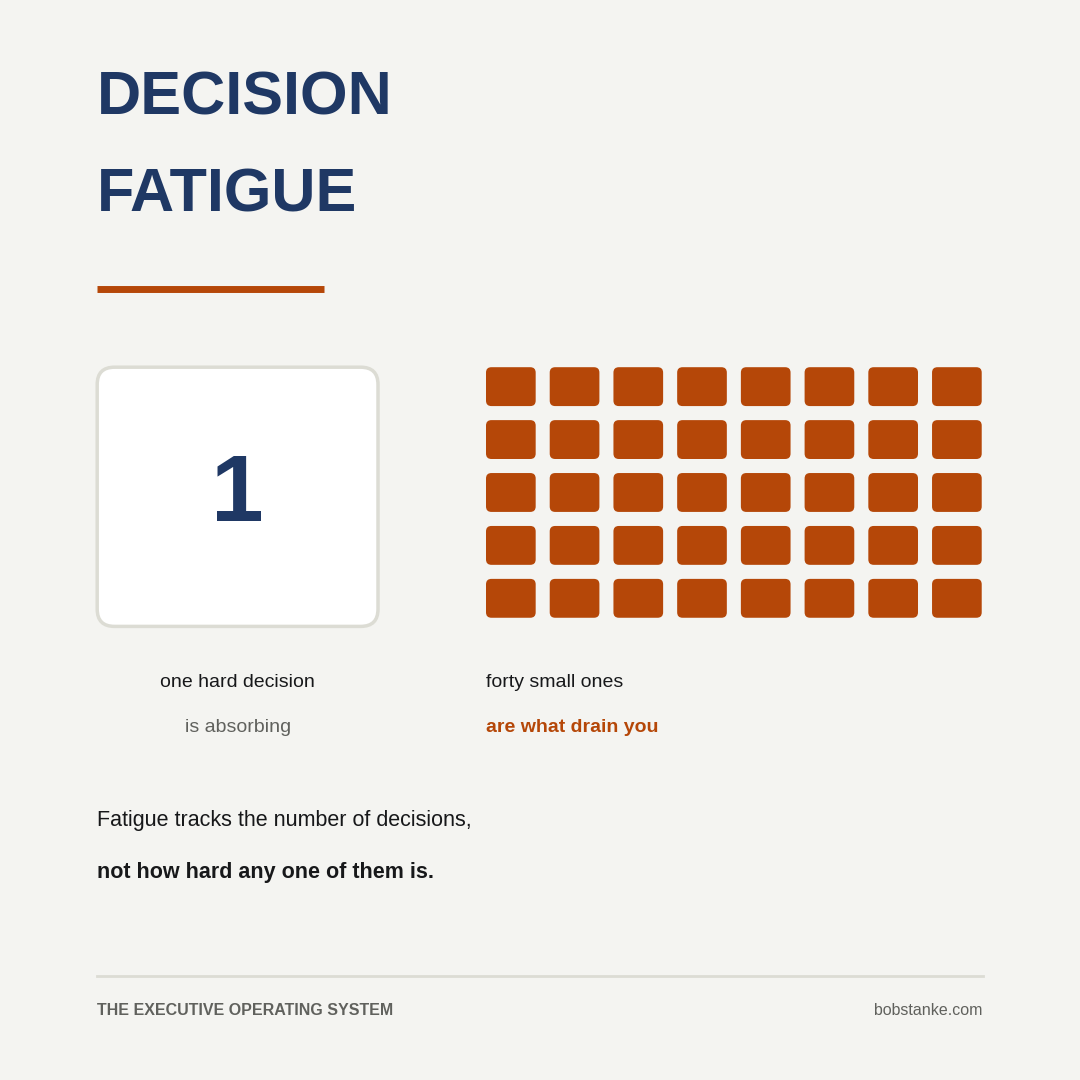
Now think about the last day you finished feeling wrung out. It was almost certainly not one hard decision. It was forty small ones, none of which mattered much individually, arriving in no particular order, each requiring you to load a different context and then drop it.
Fatigue tracks the number of decisions, not their weight. A trivial decision and a significant one cost roughly the same context switch. The trivial one just gives you nothing back.
Which means the lever is the count. And the count is not a fact about your job. It is the output of a design nobody made on purpose.
The four kinds of decision on your desk
Not all of the volume is the same, and each kind has a different fix. This is worth sorting before you try to solve anything.
| Kind | What it looks like | Why it reaches you | The fix |
|---|---|---|---|
| Undefined authority | "Can I approve this?" | Nobody knows where their limit is, so asking is the safe move | Write the thresholds down |
| Undifferentiated risk | Small reversible choices escalated like permanent ones | Everything is treated as a one-way door | Separate reversible from not |
| Legacy routing | Approvals that come to you because they always have | The original reason is gone and the path remains | Delete the step |
| Preference dressed as decision | "Which do you prefer?" where any answer works | Answering is easier than saying it is not yours | Refuse to pick |
Scroll the table sideways to see every column.
Most executives find one of these four is more than half their total volume. Sorting a week of decisions tells you which fix is worth your effort.
The last row is the one that surprises people. A meaningful share of what feels like decision load is not decisions at all. It is someone seeking cover, or seeking your attention, and every time you supply an answer you confirm the behavior.
Why the standard fixes fail
Deciding important things in the morning does nothing about the count. You have simply moved the good decisions earlier and left the same forty behind them.
Reducing trivial personal decisions is the strangest one. The famous version is wearing an identical outfit daily. Your wardrobe was never the problem. You made one clothing decision and roughly two hundred work decisions, and the advice addresses the one.
Batching approvals genuinely helps a little, because it reduces context switching. It also absorbs every item rather than questioning any of them, so the load stays and only the timing changes.
All three are coping strategies. They are what you do when you have accepted the volume, and accepting the volume is the actual mistake.
The asymmetry
Every part of an operating system has a place where the costs and benefits sit with different people, or with the same person at different times. Here is this one.
Answering the question takes five minutes. Setting the rule takes fifteen. Answering it again next week takes another five.
You feel the five minutes. You never feel the fifteen you did not spend, because the meetings that did not happen and the questions that did not arrive leave no trace. So the cheap option today is reliably the expensive option this quarter, and the arithmetic is invisible in exactly the direction that keeps you doing the wrong thing.
Nobody chooses this. It is what happens when you are busy and the fast path is right in front of you.
What actually reduces the count
1. Count them for one week. A tally mark every time a decision arrives. No categorizing, no judging, just the count. Most executives guess low by a factor of two or three, and the number is what makes the rest of this feel worth doing.
2. Sort the week's tally into the four kinds above. You are looking for which one dominates, because the fixes are different and doing the wrong one wastes the effort. Most people find one kind is more than half the total.
3. Put thresholds in writing. Dollar amounts, headcount, timeline impact, customer commitments. Below the line, decide without me. This is the single highest-yield thing on the list and it is covered properly in mapping your decision rights.
4. Answer with the rule, not the answer. When something arrives that should not have, resist deciding it. Say what the rule is from now on and let them apply it. It costs you more this once and stops costing you after.
5. Apply the reversibility test out loud. "Can we undo this within a week?" If yes, it does not need you. Say that in the moment where everyone can hear it, because the point is not this decision, it is teaching the standard.
Notice that four of the five are about changing what arrives rather than how you handle what arrives. That is the whole argument.
Where this sits in the operating system
Decisions is the third of the four components in the Executive Operating System: what reaches you, where your attention goes, what waits on your decision, what leaves your desk.
The two neighbors on both sides matter here.
Upstream, a decision problem is often an intake problem wearing different clothes. If everything reaches you, everything becomes yours to decide.
Downstream, the cost of a queue on your desk is paid almost entirely by other people, and they experience it very differently from how you do. Your team feels blocked while you feel busy covers that, and it is the argument I would read next.
If you want to know whether Decisions is actually your binding constraint or just the loudest one, the Executive Operating Index takes about six minutes and scores all four.
FAQ
What is decision fatigue?
The decline in decision quality across a day, usually explained as a depleted store of willpower. That explanation is shaky, since ego depletion research has not replicated reliably. A more useful model is volume: fatigue tracks the number of decisions reaching you rather than how hard any one of them is.
How do I reduce decision fatigue at work?
Reduce the count rather than improving your tolerance. Tally every decision for a week, sort them into undefined authority, undifferentiated risk, legacy routing, and preference dressed as decision. Then write authority thresholds down, because that single step usually removes the largest category.
Why do small decisions feel more tiring than big ones?
Because a trivial decision costs roughly the same context switch as a significant one and returns nothing for it. Hard decisions that matter are often absorbing rather than draining. A day that leaves you wrung out is usually forty small choices, not one difficult one.
Should I just batch my approvals?
Batching helps a little, by reducing context switching. It does not help much, because it absorbs every item rather than questioning whether any of them should have arrived. It is a coping strategy for a volume you have accepted, and accepting the volume is the underlying mistake.
