Manager to Director: You Are No Longer Judged on Your Team
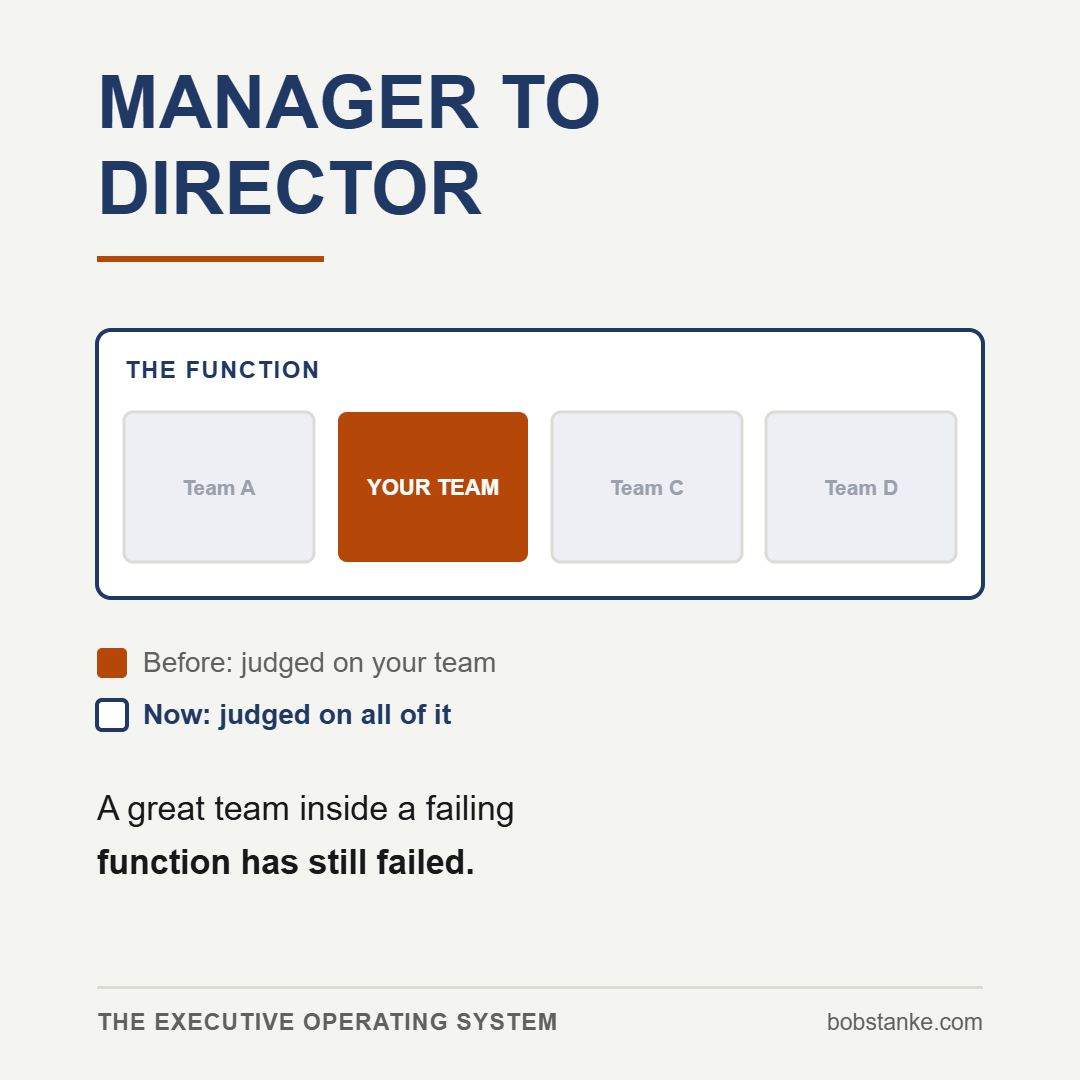
The promotion to director is the one people most often describe as a surprise, and it is not because the work is harder. It is because the thing being measured quietly changed and nobody said so.
As a manager, you were judged on your team. That is a clean arrangement. You could see the work, you could fix what was broken, and effort connected to outcome on a timescale of weeks. Work harder, ship more, look better.
As a director, you are judged on the function. Your team is now one input among several, several of the others belong to people who do not report to you, and the feedback loop has stretched from weeks to quarters.
A director who runs an excellent team inside a failing function has failed. That sentence is the whole transition, and most people take about two quarters to believe it.
What actually changed
| Manager | Director | |
|---|---|---|
| Judged on | Your team's output | The function's outcome |
| Main lever | Coaching and quality control | Allocation: people, budget, priority |
| Depends on | People who report to you | Peers who do not |
| Feedback loop | Weeks | Quarters |
Scroll the table sideways to see both columns.
The highlighted row is the one people miss. Your primary tool is no longer improvement, it is allocation, and no amount of coaching compensates for pointing resources at the wrong thing.
The second row is the one people miss. Your primary tool is no longer improvement. It is allocation.
A manager makes the team they have better. A director decides which teams get people, which projects get funded, and what the function stops doing. Those decisions dominate the outcome, and no amount of coaching compensates for pointing resources at the wrong thing.
The asymmetry underneath it
Every promotion has one of these, a place where the thing that got you here is in tension with the thing now required.
You were promoted for reducing variance. The new job is making bets.
A great manager makes their team's output predictable. Fewer surprises, fewer misses, tighter quality. That is genuinely valuable and it is what gets noticed.
A director allocates across teams and initiatives, and in any honest portfolio most of the bets will underperform. The job is to be right about the big ones and to cut the losers early, which means tolerating a level of visible failure that would have looked like poor management a year ago.
One role rewards control. The other requires giving quite a lot of it up. And the system promotes you for the first, then starts grading you on the second without ever retitling the scoreboard.
Three habits that got you here and now cost you
Being the quality backstop. You reviewed the important things and caught what others missed. At director scale there is too much to review, and reviewing anyway sends a message you do not intend. Every artifact you personally check is one the owning manager learns they do not really own. That mechanism is covered in why your team won't take ownership.
Fixing problems yourself. Fast, satisfying, and visible. It is also the most reliable way to starve a manager of the chance to develop, and it puts you back in work you are supposed to have left. Delegating so it does not come back covers why the work returns when you do this.
Optimizing your own team. The habit is not wrong, it is just no longer the highest-value thing you do. Time spent making your strongest team slightly stronger is time not spent on the allocation decision that determines whether the function hits its number.
None of these were bad habits. They were the correct behavior one level down, which is exactly what makes them hard to notice.
The part nobody warns you about
You lose your peer group.
As a manager you were surrounded by people with the same job. You could compare notes, ask whether a situation was normal, and calibrate. At director level your peers run different functions with different problems, your reports cannot help because you are their escalation path, and your boss is doing a job you have not done yet.
So most new directors go quiet at precisely the moment the job gets ambiguous, and they conclude that the confusion is a personal failing rather than a structural feature of the seat.
It is structural. Two practical responses. Build relationships with directors in other functions before you need something from them, because those are also the people whose cooperation your outcomes now depend on, and the relationship is much harder to start during a disagreement. And find one person outside your company at the same level, which is the only honest calibration available to you.
What to do in the first quarter
Write down what the function is accountable for, in outcomes rather than activities. If you cannot state it in three lines, you do not yet know what you are being measured on, and neither does anyone else.
Find the allocation decision you have been avoiding. There is usually one: a team that is overstaffed for its importance, a project nobody will kill, a commitment made before you arrived. Directors who move early on that one thing establish what the job is. Directors who wait inherit it as a permanent condition.
Decide what you are no longer the backstop for, and say so out loud. Not in a one-on-one, in a room. Unannounced delegation is not delegation, because everyone else is still working off the old map.
Then leave the loop alone for a quarter. The feedback cycle is genuinely slower now, and reading the numbers weekly will lead you to intervene on noise. That is the most common failure mode of a technically strong new director.
Where this sits in the operating system
The four components of the Executive Operating System are what reaches you, where your attention goes, what waits on your decision, and what leaves your desk. Every promotion changes the volume flowing through them, and this one changes the mix more than most.
Two adjacent reads. Once managers report to you, your information about reality starts arriving filtered, which managing managers covers. And when you are ready for the next rung, director to VP is the same exercise for a different jump.
If you want a read on which of the four is actually binding for you right now, rather than which one is loudest, the Executive Operating Index takes about six minutes.
FAQ
What changes when you move from manager to director?
What you are measured on. A manager is judged on their team's output; a director is judged on the function's outcome, including parts owned by peers who do not report to them. The feedback loop also stretches from weeks to quarters, which makes cause and effect much harder to read.
What is the main difference between a manager and a director?
The primary lever. A manager improves the team they have through coaching and quality control. A director allocates: which teams get people, which projects get funded, and what the function stops doing. Allocation dominates the outcome, and coaching cannot compensate for pointing resources at the wrong thing.
Why is the transition to director so difficult?
Because the behaviors that earned the promotion now work against you. Being the quality backstop, fixing problems yourself, and optimizing your own team were all correct one level down. They were not bad habits, which is exactly what makes them hard to notice and harder to stop.
What should a new director do first?
Write down what the function is accountable for in outcomes, not activities. Then find the allocation decision you have been avoiding, usually an overstaffed team or a project nobody will kill, and move on it early. Directors who wait inherit that problem as a permanent condition.
