How to Run a Leadership Team Meeting
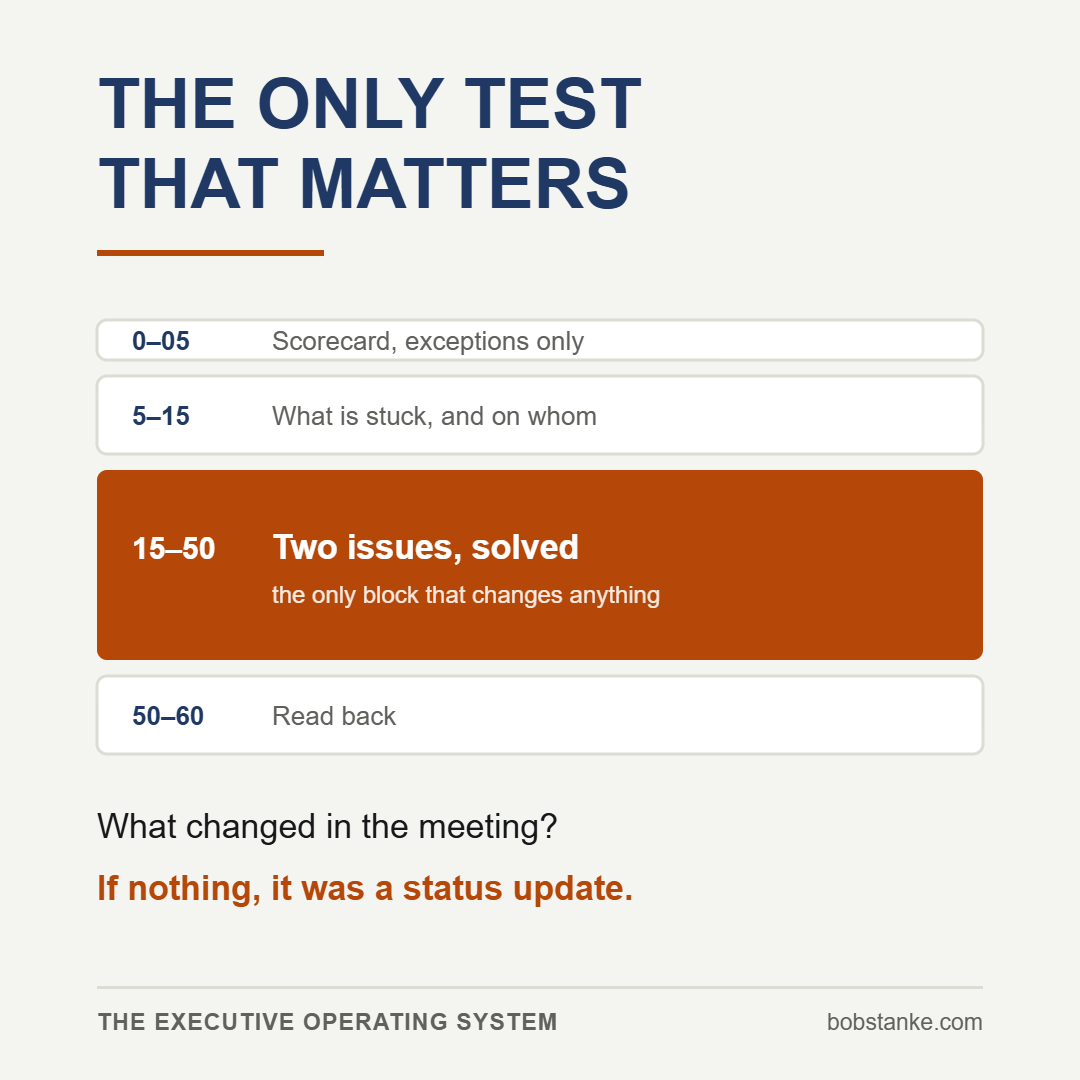
There is one test, and it is uncomfortable the first time you apply it.
What was true after the meeting that was not true before it?
Not what was discussed. Not what people are now aware of. What changed? A decision made, a direction set, a disagreement resolved, a commitment given?
Run that test on your last three leadership meetings. If the honest answer is nothing, you did not hold a leadership meeting. You held a status update.
Why it drifts that way, every time
This is not a discipline problem, and it is not because your team is passive. It is an asymmetry, and it operates on everyone in the room including you.
Reporting carries no personal risk. Deciding does.
If you report a number and the number turns out to be wrong, the information was wrong. If you make a call and it turns out badly, you were wrong. Those land very differently, and everyone in the room knows it.
So a room full of capable, rational people drifts toward the safe activity. Nobody chooses it. Nobody would defend it out loud. It just happens, week after week, until the meeting is ninety minutes of updates that could have been an email and everyone quietly agrees it is not a great use of time.
The drift is the default state. Holding a decision-making meeting is a thing you have to do on purpose, continuously, against a current.
What a leadership meeting is actually for
Three things. If an agenda item is not one of these, it belongs somewhere else.
Decisions that genuinely need the group. Not decisions you have already made and want to socialize. Ones where the input of several functions changes the answer.
Issues that cross functions. The problems that sit between two teams, where each believes the other owns it. These are the highest-value minutes in the week because nowhere else in the company are all the relevant people in one room with authority to settle it.
Calibration. Whether the leadership team is looking at the same reality. This one is easy to skip and expensive to skip, because misalignment does not announce itself. It shows up a quarter later as two teams building toward different assumptions.
Everything else is reporting. Reporting belongs in a document people read beforehand.
An agenda that produces decisions
Sixty minutes. The time boxes matter more than the sections, because the failure mode is always the same: the first item expands and the decisions get squeezed into the last four minutes.
| Time | Item | The rule |
|---|---|---|
| 0–5 | Scorecard, exceptions only | Numbers were circulated beforehand. Only off-track items get spoken. No walkthroughs. |
| 5–15 | What is stuck, and on whom | Every decision waiting more than a week, who it is waiting on, and what unblocks it. |
| 15–50 | Two issues, solved | Two. Not six. Each one ends with a decision, an owner, and a date. |
| 50–60 | Read back | Every decision made, who owns it, when it lands. Out loud, in the room. |
Scroll the table sideways to see every column.
The highlighted block is the only one that changes anything, and it is the one that gets compressed when an earlier section runs long. Protect it first. The final ten minutes are the ones people cut, and they are what makes the rest real.
The last ten minutes are the ones people cut, and they are the ones that make the rest real. Reading decisions back out loud catches the thing that quietly kills follow-through: two people leaving the room with different understandings of what was agreed. It takes four minutes and it is the highest-yield block on the agenda.
Four rules that make it hold
Numbers go out before the meeting, not during it. If someone is presenting a number the room has not seen, you are spending your most expensive hour on data transfer. Circulate the day before and treat reading it as a condition of attendance.
Every issue gets an owner and a date before the topic closes. Not "we will look into that." A name and a date, said out loud, written down. An issue that closes without both will return next week in exactly the same shape.
Ask "whose call is this" out loud. Most stuck issues are not hard, they are unowned, and checking with the group is free while deciding is not. Naming the decider in the room resolves more items than the discussion does. This is the same mechanism as mapping your decision rights, applied live.
Kill the parking lot. It sounds responsible and it is where meetings go to die. Items go to the parking lot precisely because nobody wanted to decide them, and nothing about next week makes that easier. Either give it an owner now or drop it.
What to take off the agenda
Any recurring presentation. If a slot exists because a function always presents, it is reporting with a calendar entry.
Anything only two people care about. Six people waiting through a conversation between two of them is the single most common waste in these meetings. Name it and move it to a separate five-minute call.
Your own updates, mostly. The instinct to catch the team up on what you have been doing is understandable and it eats the highest-leverage room in the company. Put it in the pre-read.
If after this the meeting only needs thirty minutes, use thirty minutes. Meetings expand to their allotted time, which is covered properly in the four meetings every executive should cancel, because a meeting nobody has questioned is the easiest kind to keep.
A note on EOS, since I run one
I am an EOS Integrator, so I run a Level 10 meeting every week. If your company runs on EOS, that structure already exists and you should use it rather than this one. It is well designed and it solves the same problem.
What I would say is that the ninety-minute L10 works because of one section, and it is not the scorecard or the rocks. It is IDS, where issues get identified, discussed and solved. Teams that struggle with the L10 almost always struggle because reporting sections expand and IDS gets compressed.
Which is the same failure described above, wearing a different label. The agenda above is a shorter, framework-agnostic version for teams not running EOS, and the principle underneath both is identical: protect the block where things get decided, because it is the only block that changes anything.
If you are weighing whether you need someone to own this rhythm rather than running it yourself, EOS Integrator vs Chief of Staff covers the difference between the two seats that usually do.
Where this sits in the operating system
A leadership meeting touches all four components of the Executive Operating System: what reaches you, where your attention goes, what waits on your decision, and what leaves your desk.
Which is why a badly run one is so expensive. It consumes the most expensive hour in the company, fails to clear the decision queue, and sends people out with no owners attached to anything. Three components damaged in a single recurring invite.
It is also why fixing the meeting rarely fixes the underlying problem on its own. If decisions pile up because nobody knows which are theirs, a better agenda moves the queue into a nicer room. The agenda is the surface. How many meetings should an executive have covers the sorting exercise that tells you whether you have a meeting problem or something upstream of it.
If you want to know which component is actually binding, the Executive Operating Index scores all four in about six minutes.
FAQ
What should be on a leadership team meeting agenda?
Four blocks in sixty minutes: five minutes on scorecard exceptions only, ten on what decisions are stuck and on whom, thirty-five solving two cross-functional issues to a decision, and ten reading back every decision with an owner and a date. Everything else is reporting and belongs in a pre-read.
How do I stop my leadership meeting turning into status updates?
Circulate numbers beforehand and treat reading them as a condition of attendance. Then protect the solving block, because the drift toward reporting is structural: reporting carries no personal risk and deciding does, so a room of rational people moves toward the safe activity every week.
How long should a leadership team meeting be?
Sixty minutes is enough for most teams, and ninety if you run EOS and use the full Level 10. Length matters far less than whether the decision block is protected. If the meeting only needs thirty minutes once reporting is removed, use thirty.
What is the single best test of whether the meeting worked?
Ask what was true after the meeting that was not true before. Not what was discussed or who is now aware of what. What actually changed: a decision made, a direction set, a disagreement resolved. If the answer is nothing, it was a status update.
